
Unreal Engine 5.8 is here: discover its 5 key features for CG artists
Epic Games has released Unreal Engine 5.8, the latest version of the game engine, also now widely used for offline animation, visual effects and visualization work.
Although Epic describes the focus of the release as “performance advancements”, it’s still a huge update, with several major toolsets, like MegaLights, becoming production-ready.
Below, you can read our pick of five of the main new features for CG artists, as opposed to programmers or game designers, from Mesh Terrain to MetaHuman crowds.
At the end of the story, you can read a summary of the changes to Unreal Engine’s other core workflows, and to its VFX, virtual production, visualization and motion graphics toolsets.
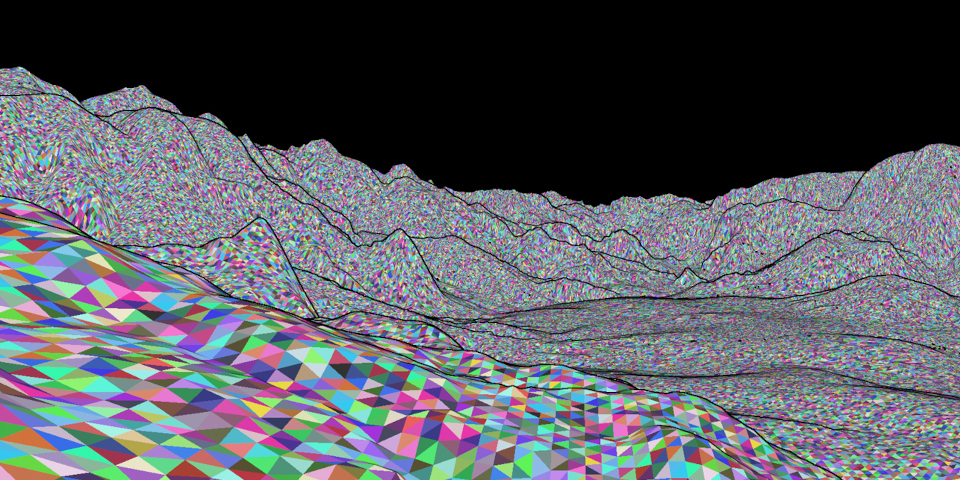
1. Mesh Terrain: the end for heightfield-based terrain in games? (Experimental)
One of the most significant new features in Unreal Engine 5.8 is Mesh Terrain, a “next-generation mesh-based terrain system” that could supersede traditional heightfield-based terrain.
Although a well-established way to represent terrain in games – and one that is well supported in third-party content creation tools like Houdini – heightfields have their limitations.
In particular, they can’t represent vertical or overhanging structures like cliff faces or tunnels, and resolution is uniform across a heightfield – in practice, meaning that the terrain they generate holds up better visually at a distance than close up.
Mesh Terrain aims to address those limitations, making it possible to create terrain with “any type of shape you can imagine”, and to increase resolution at points of interest.
Terrain development uses a non-destructive, iterative, modifier-based workflow, with artists able to refine the results manually via brush-based Sculpt and Paint modes.
The toolset also integrates with other key Unreal Engine features – in particular, Nanite and Virtual Textures, to preserve real-time performance when rendering very large textured meshes.
It also works natively with the Procedural Content Generation framework (PCG), often used to populate terrain with assets like plants and rocks.
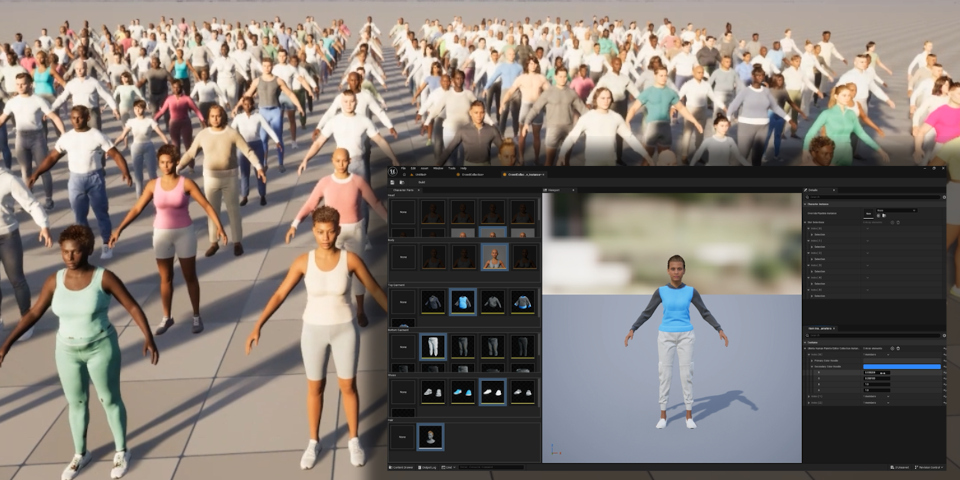
2. MetaHuman Crowd: use MetaHumans for crowds, not just hero characters (Experimental)
Unreal Engine’s MetaHuman framework for creating and animating realistic 3D characters gets a number of new features, but one of the most eye-catching is MetaHuman Crowd.
The plugin makes it possible to use MetaHumans for crowds, not just hero characters, by generating optimized instances of MetaHumans, then transitioning from high-fidelity characters to lower-fidelity instanced skeletal meshes as distance from the camera increases.
Textures are also optimized to reduce the memory footprint of more distant instances.
According to Epic, the workflow scales from “tens to thousands” of characters, and isn’t simply for PCs and consoles: the sample project runs on “all Unreal Engine target platforms”.
The crowds are compatible with MassEntity, Unreal Engine’s framework for handling AI crowd behavior, and can be rendered either with Nanite or dynamic LOD systems.
To generate visual variation in crowd actors, artists can use existing MetaHuman tools to build libraries of faces, bodies, hair and clothing, then use Blueprints to assign them procedurally.
3. Direct Mesh Control: animate by manipulating character meshes directly (Experimental)
There are a number of changes to character rigging and animation in Unreal Engine 5.8, but one that particularly caught our eye is the Direct Mesh Controls (DMC) system.
It provides a way to represent Control Rig controls on sections of the skeletal mesh, making it possible to pose characters by pulling body parts around directly.
The workflow – also used in the in-house tools of leading animation and VFX studios – is often faster and more intuitive than manipulating traditional shape-based rig controls.
It is supported in both the viewport and the Sequencer, Unreal Engine’s cinematics editor.
According to Epic, mesh-based controls are intended to complement shape-based controls, not replace them, with traditional controls remaining more appropriate for body parts like tails.
4. Control Rig Dynamics: a new lightweight solver for secondary motion (Experimental)
Another interesting new animation feature is Control Rig Dynamics, a new lightweight particle-based solver built directly into Control Rig.
It is intended to generate believable secondary motion for characters – like the motion of clothing, hair, or body parts like tails – without the need to run a full physics simulation.
According to Epic, it provides a “5x runtime performance improvement” over existing physics solutions, like Chaos Cloth or Chaos Flesh, and is “purpose-built for in-game cosmetics”.

5. MegaLights: better visual fidelity, performance and stability
Outside the new features, one of the most significant features of recent releases – MegaLights, the ‘Nanite of lights’ introduced in Unreal Engine 5.5 – is now production-ready.
One of the reasons for the change of status is simply improved performance: the changelog on Epic’s online roadmap suggests that it can now achieve a 60fps frame rate in typical games.
Another is improved visual fidelity, through support for subsurface scattering, froxel (camera-aligned voxel) translucency, lighting channels and cloud shadows.
Noise has also been “greatly reduced”.
Users also get new tools for debugging and troubleshooting MegaLights setups, including a Light Finder Tool, and a Ray Visualizer to show ray iterations within a level.
Updates to other core toolsets
The new features listed above are only a small fraction of the hundreds included in Unreal Engine 5.8, so to conclude, let’s take a quick look at what’s new in the other key toolsets.
The Unreal Editor gets a redesigned gizmo system, unifying the behavior of many of the legacy gizmos, and introducing new features designed to make it easier to make fine adjustments.
The changes were “inspired by workflows … from tools like Maya and Blender”, and the gizmos actually have a mode for Maya-style interactions, as well as the new and legacy behaviors.
Substrate, Unreal Engine’s modular material authoring framework gets a new NPR mode for stylized materials, although it’s still experimental, and does not yet support forward rendering.
In addition, the Material Preview Editor now includes a standard shader ball as a preview mesh.
As well as MegaLights becoming production-ready, lighting artists get Lumen Lite, a faster, “medium-quality” version of the real-time GI system aimed at consoles.
Changes to rendering include Fog Screen Space Scattering (FSSS), better approximating the way that light is scattered in fog, smoke and dust. It’s an experimental feature, and supports Unreal’s Volumetric Fog and Local Fog Volumes, but not the newer Heterogeneous Volumes.
Rigging artists get updates to a lot of key tools, including updates to the Modular Control Rig and Control Rig Physics.
There are also new features in Control Rig and the Skeletal Editor to support blendshape-based workflows, both for in-editor blendshape authoring, and corrective sculpting on shots.
Animators get experimental support for animation mixing in Sequencer, and updates to animation retargeting, including override sets and updates to Rig Mapper.
MetaHuman Animator (MHA) is now available in-editor on Linux and macOS as well as Windows.
The Simulation tools get a lot of small individual updates, including to Chaos Hair, Chaos Fluids, Chaos Destruction and the simulation core.
Another interesting tidbit from the release notes is that Epic is working to unify the solvers of Chaos Flesh and Chaos Cloth, for better interactions between tissue layers like muscle and skin.
Chaos Cloth also now supports round-tripping of assets with Marvelous Designer.
In the industry-specific toolsets, the motion design tools introduced in Unreal Engine 5.4 get performance and workflow improvements, including the option to combine masks.
For VFX artists, the Movie Render Graph is now production-ready, and gets a new accumulation depth of field system that plays nicer with deferred rendering.
Visualization professionals get support for X-Rite’s AxF format in Substrate. The AxF standard provides a way to transfer scanned materials between DCC and CAD tools that support it.
However, arguably the biggest changes to industry-specific tools are to virtual production.
Composure, the real-time compositor reintroduced in Unreal Engine 5.7 now supports experimental depth-based workflows, projecting an imported depth map as a World Position Offset static grid mesh, to help recreate occlusion and shadow positions.
The update also introduces Tiled Mipmap Video (TMV), a new video container intended to reduce the file size overheads and bandwidth requirements for playing back EXR image sequences – Epic says that scrubbing performance is on a par with ProRes.
There are also updates to the other key virtual production tools, including Live Link Hub, VCam, mocap manager, and nDisplay: you can see all of the changes in the online product roadmap.
For AI workflows, an experimental Model Context Protocol (MCP) plugin for the Unreal Editor makes it easier to connect LLMs like Claude to Unreal Engine.
Developers also get updates to incremental cooking and Horde Analytics, and audio artists get updates to the waveform editor and subtitling system.
Price and system requirements
Unreal Engine 5.8 is available in preview for 64-bit Windows, macOS and Linux.
For non-interactive content, the software is free to users with revenue under $1 million/year. For larger studios, subscriptions cost $1,850/seat/year, including Twinmotion and RealityCapture.
For games developed with the engine, Epic takes 5% of the gross royalties after the first $1 million generated.
Read an overview of the new features in Unreal Engine 5.8 on Epic Games’ blog
Read more about the new features in the product roadmap
Have your say on this story by following CG Channel on Facebook, Instagram and X (formerly Twitter). As well as being able to comment on stories, followers of our social media accounts can see videos we don’t post on the site itself, including making-ofs for the latest VFX movies, animations, games cinematics and motion graphics projects.