
Otoy releases OctaneRender 2027.1 in alpha
OctaneRender 2027.1’s neural rendering mode promises “near noise-free interactive rendering”, even of complex lighting and material effects, such as subsurface scattering.
Originally posted on 16 March 2026, and updated with details of Alpha 2.
Otoy has begun releasing public alpha builds of OctaneRender 2027.1, the next major version of the GPU production renderer.
The experimental build – available in parallel to the stable OctaneRender 2026 releases – adds a new real-time ‘neural rendering’ mode, an update to the AI Light system, and USD export.
Below, you can read our summary of the new features, which other features are currently scheduled for future alpha builds, and when you can expect the stable release.
Alpha 1: new neural rendering mode improves viewport renders of complex scenes
Key changes in OctaneRender 2027.1 include the new “neural rendering” mode to improve performance and reduce noise in viewport renders.
It builds on the neural radiance cache (NRC) system introduced in OctaneRender 2026, which uses a neural network trained at render time to reduce noise on first pixel.
According to Otoy, neural rendering “enables near noise-free interactive rendering” with “very low sample counts compared to traditional path tracing, even in complex lighting conditions”.
The system is based on both the ray reconstruction system in NVIDIA’s DLSS (Direct Learning Super Sampling) AI rendering technology, and Otoy’s own research.
OctaneRender 2027.1 also introduces two new render upscaling technologies: DLSS 4 and AMD’s FSR 3 (FidelityFX Super Resolution) – the latter for NVIDIA GPUs only, since OctaneRender is CUDA-based.
Alpha 1: AI Light 2.0 reduces noise in scenes with many light sources
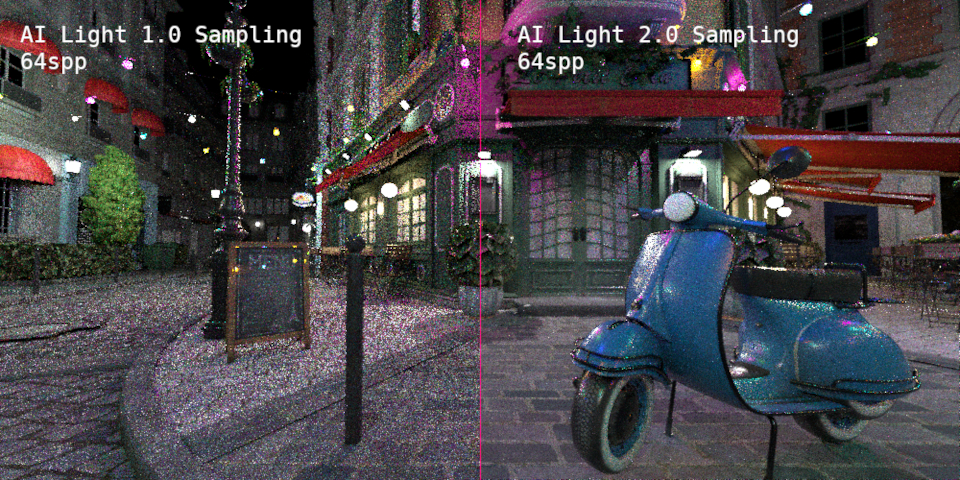
AI Light, OctaneRender’s hierarchical algorithm for sampling scenes with multiple light sources, gets its first major update since it was originally introduced in OctaneRender 4.0.
It now incorporates “full spatial and directional information” for all emissive primitives, reducing noise for a given sample count: you can see a side-by-side comparison above.
Alpha 1: USD export and extended MaterialX support
The release also extends support for USD and MaterialX workflows.
Firstly, OctaneRender can now export geometry in USD format as well as import it – USD import was added in OctaneRender 2021 – with “limited support” for USD Preview Surface materials.
The standalone edition of OctaneRender now includes a USD Stage editor, making it possible to select variants and layers in a USD scene without the need to save and reopen the USD file.
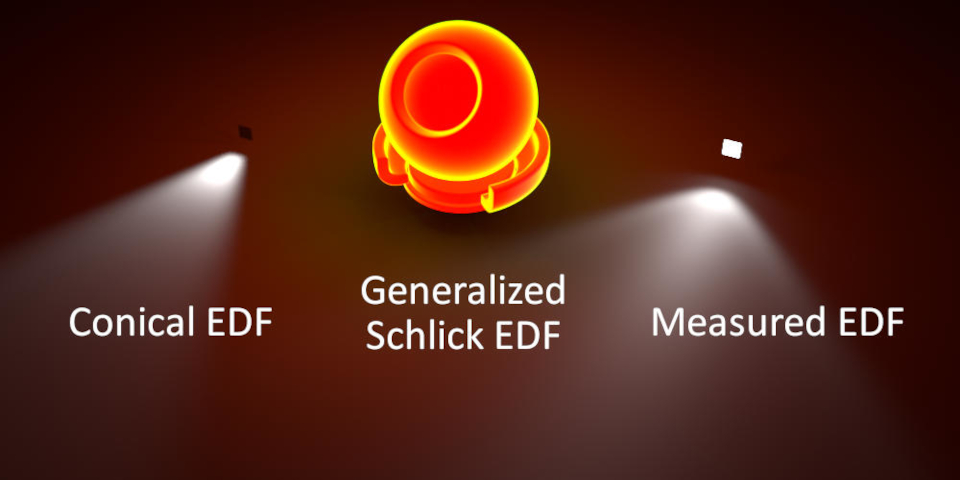
Support for the MaterialX open material standard, introduced in OctaneRender 2026, has been extended with three new EDF (Emission Distribution Function) nodes.
Other new features and workflow improvements
Other changes include a new Vectron tube primitive, and support for named UV vertex attributes.
The maximum number of UV maps allowed per primitive has also been raised from three to 10.
Alpha 2: new Physical Optics material for complex iridescent surfaces
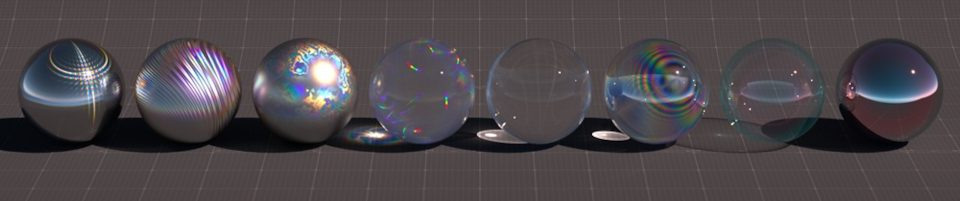
To that, Alpha 2 adds a new Physical Optics material, for rendering wave optics surface effects like diffraction, thin film interference, and birefringent iridescence.
It replicates surfaces with both random roughness and regular microscopic structures, such as gratings or parallel grooves, making it possible to recreate a range of real-world materials.
Examples shown in the release thread on the Otoy forum range from soap bubbles to brushed metal, holographic stickers and the surfaces of CDs and DVDs.
New retroreflective microfacet material model for directly reflective surfaces
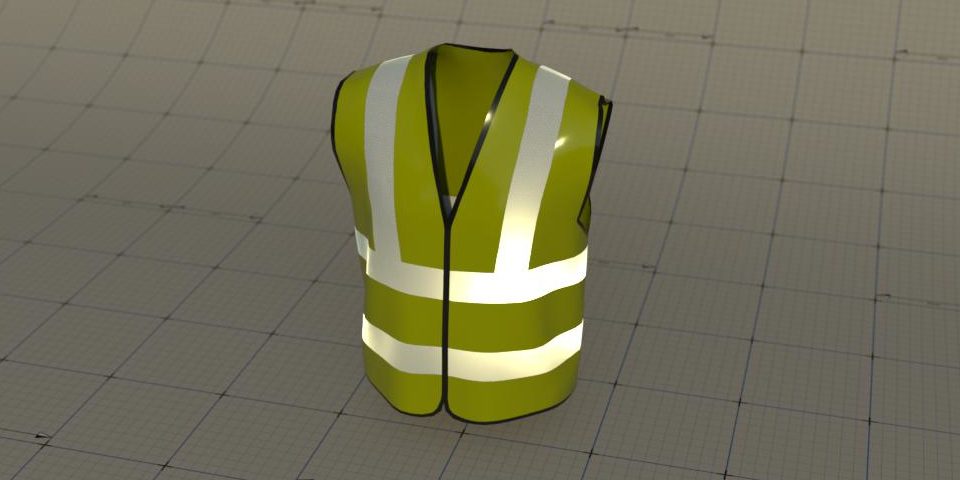
Another eye-catching change to materials is the new retroreflective microfacet model.
It mimics real-world surfaces designed to reflect light rays directly back at the source, rather than scattering them, like traffic signs and high-vis clothing.
It is currently only exposed in specular and metallic layers and materials, but Otoy plans to integrate it further before the stable release.
New environment map visibility cache reduces noise in dimly lit interior renders
Alpha 2 also introduces a new environment map visibility cache option for the Texture environment and Daylight environment nodes.
It improves sampling of HDRI environments, particularly under low light conditions, and is suited to renders of interiors where most of the illumination comes from an external source.
Enabling the cache reduces noise in renders, at the expense of increasing VRAM usage.
The initial implementation is only available on Windows and Linux, does not support network rendering, and has a number of other technical limitations.
Other changes include initial support for the glTF 2.0 specification, and support for MetalFX upscaling in Octane X, the macOS edition of the renderer.
What other features are scheduled for OctaneRender 2027.1?
Features currently due to be added to OctaneRender 2027.1 before the stable release include the much-delayed Anime and Sketch renderer, and the option to render to 3D Gaussian Splats.
Otoy also plans to add new AI features, including built in PBR material generation, and integration with Otoy Studio, its new set of online generative AI tools.
You can read a full list of changes planned in the OctaneRender 2027.1 online roadmap.
How long will it take OctaneRender 2027.1 to reach a stable release?
In recent years, it has taken 6-12 months for major versions of OctaneRender to go from initial alpha to stable release.
The first public alpha of OctaneRender 2027.1 was released in March 2026, which would suggest a stable release at the end of 2026.
Price, system requirements and release date
OctaneRender 2027.1 is currently in public alpha for Windows 10+, Linux and macOS 15.0+.
The software is rental-only, via Otoy’s Studio+ subscriptions, which cost €23.95/month or €239.88/year, and which include integration plugins for 21 DCC applications, plus a range of third-party software.
Otoy also provides free ‘Prime’ editions of both OctaneRender and Octane X, which are limited to rendering on a single GPU, and which come with a smaller set of DCC integration plugins.
Read a full list of new features in OctaneRender 2027.1 Alpha 1 and Alpha 2 on Otoy’s forum
(Includes download links for the alpha builds)
Have your say on this story by following CG Channel on Facebook, Instagram and X (formerly Twitter). As well as being able to comment on stories, followers of our social media accounts can see videos we don’t post on the site itself, including making-ofs for the latest VFX movies, animations, games cinematics and motion graphics projects.