
Autodesk releases Arnold 7.5.3
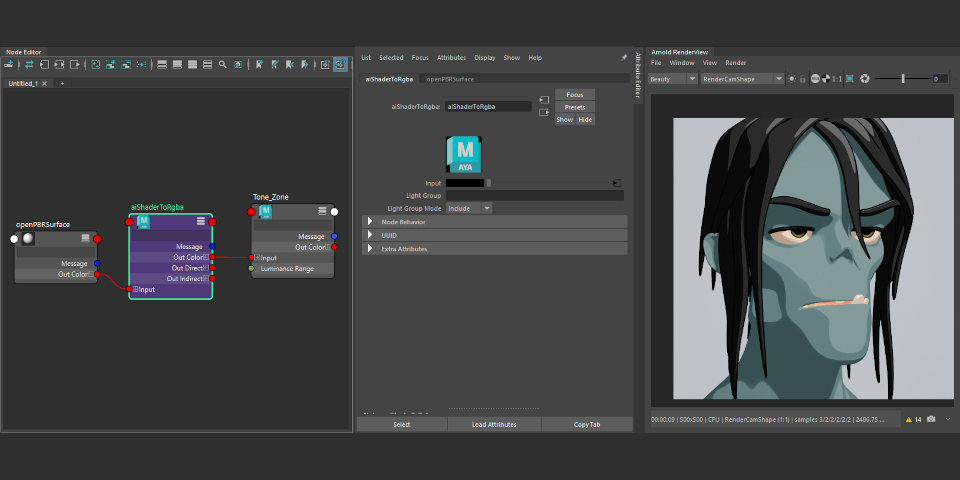
Arnold 7.5.3 introduces three new BSDF nodes that can be connected to the Shader to RGBA node to create non-photorealistic render effects like toon shading.
Autodesk has released Arnold 7.5.3, the latest version of the production renderer.
The update introduces new BSDF nodes for toon shading, and makes a lot of performance improvements, particularly to GPU rendering and interactive rendering.
Flow Render, the cloud rendering service currently available free to Arnold subscribers, gets a new turntable rendering system, support for texture baking, and can now handle larger jobs.
New BSDF nodes make it easier to build toon shading effects
Arnold 7.5.3 introduces new Diffuse BSDF, Fuzz BSDF and Specular BSDF nodes.
The new nodes are intended for use with the Shader to RGBA node, making it easier to build non-photorealistic looks like toon shading.
The new Accelerated Viewport option in Arnold for Maya improves interactive performance. You can see videos comparing viewport performance with the previous version of Arnold here.
Faster GPU and interactive rendering
However, most of the changes in the update are performance improvements.
In GPU renders, time to first pixel is now “1-4x faster” – it’s 2.25x faster for the standard ALab USD scene – and rendering is overall “1-20%” faster.
In interactive renders, poly meshes are now updated incrementally rather than fully rebuilt on each edit, with “typical vertex and deformation edits on dense meshes [now] 2–2.5× faster”.
The Maya plugin gets a new Accelerated Viewport option that uses GPU rendering and DLSS denoising to improve interactive performance: you can see the effect in the video above.
The lightweight instancing system previously only available in USD workflows is also now available to any plugin that uses an Arnold instancer node.
3ds Max, Cinema 4D and Maya users get a new turntable animation feature in Flow Render.
Flow Render: longer renders, new turntable system, and support for texture baking
Outside the core application, Flow Render, the experimental new cloud rendering service launched alongside Arnold 7.5.1, now handles longer renders.
Multiple-frame renders can now be grouped into a single task when submitting a render job, and render jobs can now run for up to 24 hours, making it easier to render animations.
In addition, a new turntable render feature makes it possible to render turntable animations of models without having to set up cameras or lights manually.
Flow Render also now supports texture baking, as well as final-quality rendering.
Aimed mainly at indie artists who want to avoid tying up local machines while rendering, Flow Render is currently free to all Arnold users, for up to 40 hours of rendering per month.
Support in the integration plugins
All of Arnold’s integration plugins have been updated to support the new features:
3ds Max: MAXtoA 5.9.4
Cinema 4D: C4DtoA 4.9.3
Houdini: HtoA 6.5.3
Katana: KtoA 4.5.3
Maya: MtoA 5.6.3
At the time of writing, the Houdini and Katana plugins don’t support all of the new Flow Render features, but support is planned for future updates.
System requirements and availability
Arnold 7.5.3 is available for Windows 10+, glibc 2.28+ Linux and macOS 12.0+. Integrations are available for 3ds Max, Cinema 4D, Houdini, Katana and Maya.
GPU rendering is supported on Windows and Linux only, and needs a compatible NVIDIA GPU.
The software is rental-only, with single-user subscriptions costing $55/month or $430/year.
Read a full list of new features in Arnold 7.5.3 in the online documentation
Have your say on this story by following CG Channel on Facebook, Instagram and X (formerly Twitter). As well as being able to comment on stories, followers of our social media accounts can see videos we don’t post on the site itself, including making-ofs for the latest VFX movies, animations, games cinematics and motion graphics projects.