
Maxon releases Cinema 4D 2027.0
Maxon’s trailer for its Fall 2026 product updates. The section on Cinema 4D 2027.0 starts at 2:20.
Maxon has released Cinema 4D 2027.0, the latest version of its 3D software for motion graphics, VFX and visualization work.
The release introduces a new scattering system for populating environments with rocks, debris and vegetation, and dedicated tools for adding spray and foam to liquid simulations.
Other changes include new Scene Nodes for building custom fields and MoGraph setups from node graphs, and the option to paste data into Autograph, Maxon’s free motion graphics app.
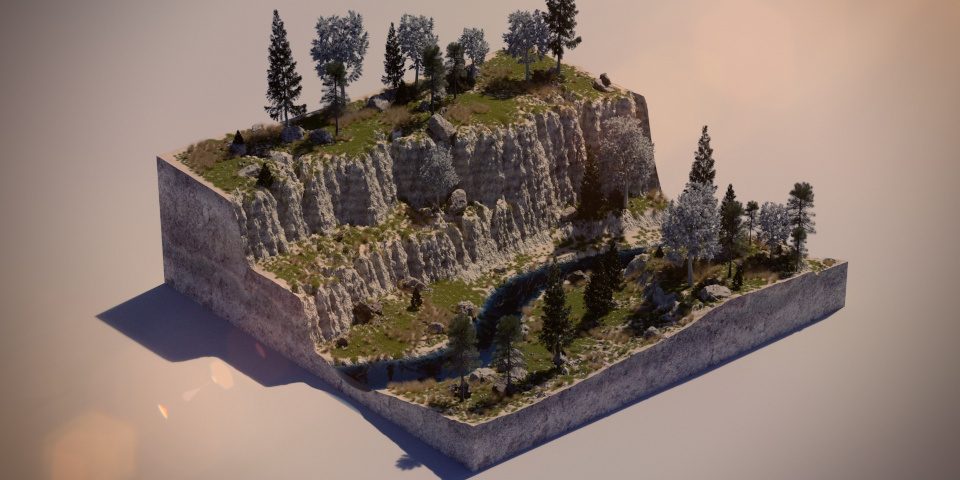
New dedicated, MoGraph-compatible object scattering system
The main new feature in Cinema 4D 2027.0 is the new scattering system, which Maxon describes as “one of the … most-requested capabilities” among Cinema 4D users.
It enables layout artists and architectual visualization professionals to populate environments with assets like vegetation, rocks, debris, and even crowds.
There are two key components, both part of MoGraph, Cinema 4D’s motion graphics toolset.
The Scatter Generator scatters objects within a scene, with options to distribute them across a surface, along a spline, or according to a UV layout.
The scattering pattern can be controlled using texture maps – both scatter and density maps – and by using Filters or Proximity settings to restrict scattered objects to parts of a scene.
Other sets of controls make it possible to cluster scattered objects; and to set up random variation in position, scale and color.
The second component of the scattering system, the Scatter Tag, makes it possible to override the scattering settings on a per-object basis.
Although it was possible to scatter objects using existing MoGraph features, such as the Cloner object and Fields, Maxon says that the new system provides a faster, easier way to do so.

LiquidFX adds foam, spray and bubbles to liquid simulations
VFX and motion graphics artists get an update to Cinema 4D’s liquid simulation system.
Although liquid simulation was initially introduced in Cinema 4D 2025.3, there were notable limitations, particularly for larger-scale simulations.
The latest update addresses some of those limitations, adding new dedicated ‘Liquid FX’ features for adding spray, foam and bubbles to an existing liquid simulation.
The Liquid FX Emitter evaluates the particles of an existing simulation, and emits new Liquid FX particles from them.
It generates particles at fast-moving curved areas of the liquid surface, creating foam and spray at wave crests, and where air is trapped in the body of a liquid, creating bubbles.
The Liquid FX Modifier converts existing particles directly into Liquid FX particles.
It works throughout the volume of a liquid: for example, generating rising bubbles in a glass.
Updates to the Scene Nodes system
Cinema 4D’s Scene Nodes system also gets several new features.
The Scene Nodes Field object builds a custom file from a node graph, which Maxon says is “more efficient than the Python Field and more powerful than the Formula Field”.
The Scene Nodes Effector does a similar job for MoGraph setups.
Both are compatible with the new MCP Server introduced in Cinema 4D 2026.4, making it possible to control them with third-party AI tools like Claude Desktop or ChatGPT Desktop.
Workflow and pipeline integration improvements
Workflow improvements support for grouping Tags, and updates to the viewport display, including a new Random object color display mode.
The HUD display can now show usage hints for key tools, like modifier keys and the mouse buttons supported.
Visualization artists can import CAD data in a wider range of formats, including 3MF, 3DXML and IFC, and files from Autodesk’s Inventor, Siemens’ NX and Solid Edge, and PTC’s Creo software.
Motion designers can now paste Cinema 4D cameras, lights, primitives, planes, text and nulls directly into Autograph, Maxon’s free motion graphics software.
Ships with Redshift 2027.0
Cinema 4D 2027.0 also ships with Redshift 2027.0, the latest version of Maxon’s GPU renderer.
It’s a significant update, so we’ll cover its new features in a separate story, but they include a new Fur procedural, updates to real-time renderer Redshift Live, and support for ACES 2.
Price, system requirements and release date
Cinema 4D 2027.0 is compatible with Windows 11 and macOS 15.0+. It is available rental-only, with Cinema 4D subscriptions costing $109/month or $839/year.
Read a list of new features in Cinema 4D 2027.0 in the online release notes
Read more about the new features in Maxon’s online documentation
Have your say on this story by following CG Channel on Facebook, Instagram and X (formerly Twitter). As well as being able to comment on stories, followers of our social media accounts can see videos we don’t post on the site itself, including making-ofs for the latest VFX movies, animations, games cinematics and motion graphics projects.