
World Machine ‘Dragontail Peak’ now runs on macOS and Linux
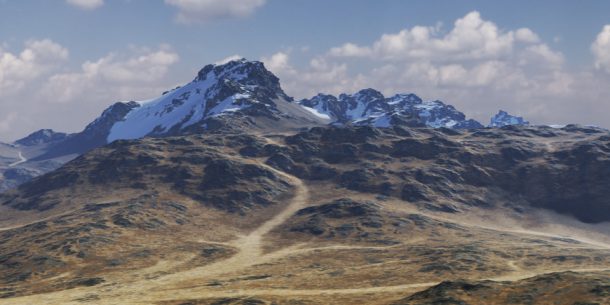
Originally posted on 18 May 2026 for Build 4058, and updated for Build 4065.
World Machine Software has begun its ‘Dragontail Peak’ series of releases for World Machine: the latest major version of the terrain-generation software for games and VFX work.
The first build, World Machine 4059, introduced ‘true 3D terrain’ – terrain based on Vector Displacement Maps (VDMs) rather than heightfields, making it possible to generate overhangs.
Other changes include an overhaul of the 3D viewport, which gets support for HDR lighting and environment fog, and a lot of improvements to common workflows.
The current build, World Machine 4065, makes the formerly Windows-only software available on macOS and Linux, and overhauls the software’s UI.
One of the original terrain generation tools for games and VFX
First released over two decades ago, World Machine is one of the original terrain tools.
Terrain can be created using a combination of manual input and node-based procedural workflows, with users able to import a base mesh or rough one out by hand, then run simulations on it to mimic the effect of erosion, snow deposition and water action.
As well as the terrain geometry, the software can generate PBR textures.
The results can be exported as 3D meshes in glTF or OBJ format, or as 2D textures – including heightmaps and splat maps – in EXR, PNG and TIFF format.
The terrain can then be used in DCC applications – the online feature list namechecks 3ds Max, Blender, Cinema 4D and Maya – or game engines like Unity and Unreal Engine.
The testimonials on the product website are now very old, but the software has been used by AAA game developers and VFX studios.
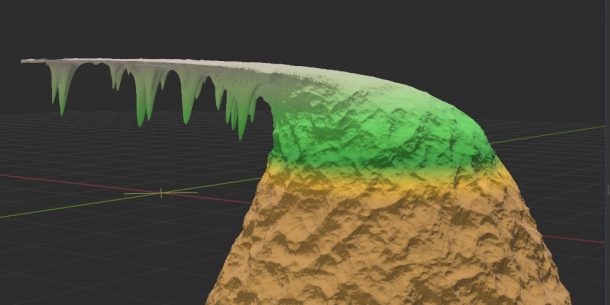
Now supports VDM-based terrain to generate true overhangs
The main change in the Dragontail Peak releases is that the software can now represent terrain as Virtual Displacement Maps (VDMs), not just heightfields.
Although heightfields are the standard 2D format in which to represent terrain, and are widely used in other terrain-generation tools and DCC apps, they do have limitations.
The main one is that they can’t describe overhanging surfaces, so they begin to break down on very steep slopes, or when generating terrain at very high resolutions.
Although more familiar from digital sculpting applications like ZBrush, Blender and 3DCoat, Vertex Displacement Maps (VDMs) provide a way to represent those overhanging surfaces.
That makes it possible to create “overhangs, undercuts, caves, and proper cliffs” – although, as this blog post discussing the pros and cons of VDM terrain points out, while you can create a detailed cave system, you can’t create a cave mouth, as VDMs don’t support holes.
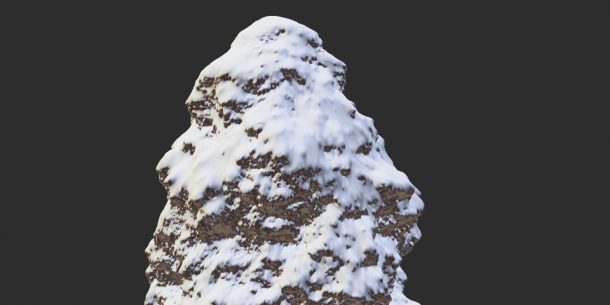
Most existing devices support VDM terrain, including Erosion and Snow
Most of World Machine’s key ‘devices’ – tools for selecting and modifying terrain – now support VDM workflows, making it fairly straightforward to update existing node graphs.
Devices currently supported include basic tools like file input; Strata, Tiling and Blur; and simulation systems for Erosion, Thermal Weathering and Snow.
The devices for creating surface water – like rivers and oceans – are not supported in Build 4059, although this is planned for future updates.
There is also a new set of devices for creating VDMs directly, by generating and combining primitive shapes, and applying noise and displacement.
Other new devices repair common artefacts in VDM terrain, and optimize it for export.
As well as exporting VDMs directly as 32-bit EXRs, users can convert VDM terrain to a 3D mesh, or a mesh plus a heightfield, for use in existing production pipelines.
Other updates to devices
In addition, several of the existing devices get new controls that can be used in either VDM- or heightfield-based workflows.
Highlights include a new fractal mode for the Voronoi noise device, and support for directional falloff in the Height Selector and Slope Selector devices.
Support for HDR lighting and environment fog in the 3D viewport
World Machine’s 3D viewport gets a major overhaul, including the option to load a HDR panorama and use it both as a skybox background and environment lighting source.
It is also possible to apply height fog to add atmospheric depth when previewing terrain.
Workflow improvements to the viewport include support for side-by-side A:B comparison of terrain, to make it easier to evaluate changes.
Workflow improvements
Dragontail Peak also features a lot of more general workflow improvements, particularly to the node graph, macros, and file export.
Changes to the node graph include a Wire Slice tool for cutting through multiple node connections with a single stroke, and velocity-sensitive grid snapping.
Macros and custom devices are now “first-class citizens” in the software, meaning that they can now be accessed from the main Devices menu, and support versioning.
There is also now a single Build & Export button to build and export all outputs.
Also available for macOS and Linux after over 20 years as a Windows-only application
In addition, World Machine – for over 20 years, a Windows-only application – is now available for macOS and Linux.
The release notes don’t give system requirements, but World Machine Software had previously announced that it planned to support Ubuntu.
Price, system requirements and release date
World Machine is compatible with Windows 10+, Linux and macOS. It supports both Intel and Apple Silicon Macs.
Indie licences, which let you build terrains on four CPU threads, cost $119. Professional licences – which remove the CPU limit, and add tiled terrain export – costs $299.
There is also a free edition for non-commercial work, which restricts the terrain generated to 1,025 x 1,025px resolution.
Read a full list of new features in World Machine in the online release notes
Read more about the Dragontail Peak updates on the World Machine blog
Have your say on this story by following CG Channel on Facebook, Instagram and X (formerly Twitter). As well as being able to comment on stories, followers of our social media accounts can see videos we don’t post on the site itself, including making-ofs for the latest VFX movies, animations, games cinematics and motion graphics projects.