
World Machine will support VDM-based terrain, not just heightmaps
The website demo for World Machine. The veteran terrain generation software will become available for macOS and Linux as well as Windows in the upcoming Dragontail Peak releases.
Posted on 11 March 2026, and updated with more details of the Dragontail Peak releases.
Veteran terrain generation software World Machine is finally coming to macOS and Linux after over 20 years as a Windows-only application.
The upcoming Dragontail Peak releases will feature “some of the largest changes that have ever been made to World Machine”, including support for Apple Silicon Macs and Linux systems.
The updates will also change the way that World Machine handles macros – and introduce support for terrain represented as Vector Displacement Maps (VDMs), not just heightfields.
One of the original terrain generation tools for games and VFX
First released over two decades ago, World Machine is one of the original terrain creation tools.
It makes it possible to create CG terrain using a combination of manual input and node-based procedural workflows, with users able to import a base mesh or rough one out by hand, then run simulations on it to mimic the effect of erosion, snow deposition and water action.
As well as the terrain geometry, the software can generate PBR textures.
The results can be exported as 3D meshes in glTF or OBJ format, or as 2D textures – including heightmaps and splat maps – in EXR, PNG and TIFF format.
The terrain can then be used in DCC applications – the online feature list namechecks 3ds Max, Blender, Cinema 4D and Maya – or game engines like Unity and Unreal Engine.
The testimonials on the product website are now very old, but the software has been used by AAA game developers and VFX studios.
Still updated regularly, just with little fanfare
In the past, World Machine Software has tended not to publicise new releases heavily: it isn’t unheard-of for users to post on the forum to ask if developer Stephen Schmitt is still alive.
The last time we covered the software on CG Channel was in 2021, with the Mt. Rainier release, but there have been two major new versions of World Machine since then.
Artist Point, released in 2022, added PBR rendering. Hurricane Ridge, released in 2024, added new erosion and thermal weathering models, and made some major performance updates.
Now coming to macOS and Linux after over 20 years as a Windows-only application
Schmitt has now reactivated the World Machine blog to make a major announcement: that the formerly Windows-only software will support macOS and Linux.
The upcoming Dragontail Peak release will make World Machine available on Apple Silicon Macs and on x64 processors under Ubuntu.
Other major changes in the Dragontail Peak releases
Schmitt describes Dragontail Peak as featuring “some of the largest changes that have ever been made to World Machine”, including two other major development initiatives.
The first is that macros and Code Devices – user-created custom plugins – are now ‘first-class citizens’ inside World Machine.
In practice, that means that they can both be accessed through a single menu, browsed from the library, and favorited to the toolbar.
They also now have full versioning support, meaning that when a macro or device is updated, World Machine automatically updates worlds using it, or shows a warning of breaking changes.
Interestingly, the update switches the Code Devices framework to Slang for writing compute shaders, as an alternative to the now effectively defunct OpenCL.
That makes World Machine one of the first CG apps we’ve seen using the cross-platform shader authoring language, which is now backed by open standards body Khronos Group.
Slang code can be cross-compiled to multiple APIs and platforms, including Apple’s Metal Shading Language, HLSL for Direct3D, GLSL for OpenGL, and SPIR-V for Vulkan.
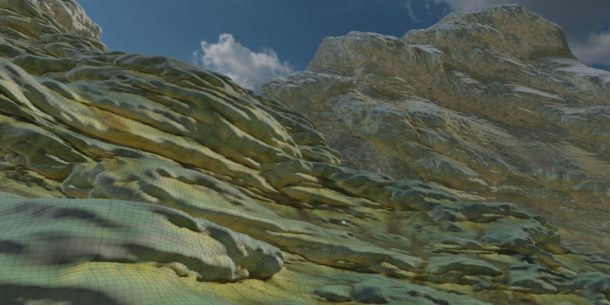
Support for VDM-based terrain, not just heightmaps
The second – and bigger – change is that the Dragontail Peak releases will be able to represent terrain as Virtual Displacement Maps (VDMs), not just heightfields.
Although heightfields are the standard 2D format in which to represent terrain, and are widely used in other terrain-generation software and DCC applications, they do have limitations.
The main one is that they can’t describe overhanging surfaces, so they begin to break down on very steep slopes, or when generating terrain at very high resolutions.
Although more familiar from digital sculpting applications like ZBrush, Blender and 3DCoat, Vertex Displacement Maps (VDMs) provide a way to represent those overhanging surfaces.
In a recent blog post, Schmitt discusses the pros and cons of the two workflows, and how support for VDM terrain will be implemented in World Machine.
As well as extending many existing heightfield-based devices, including erosion, to VDMs, the Dragontail Peak releases will introduce VDM-specific 3D noises and surface displacement.
There will also be VDM-specific tools for fixing common issues and optimizing terrain.
For pipeline integration, it will be possible to convert VDM terrain as a 3D mesh or generate a standard heightfield from it, as well as exporting VDMs natively as 32-bit EXRs.
Price, system requirements and release date
World Machine is compatible with Windows 10+.
The Dragontail Peak update is in closed alpha, but no date has been announced for the public release, and neither the macOS or the Linux editions will be available with the first public build.
An Indie licence, which enables you to build terrains on two CPU cores, costs $119. A Professional licence – which removes the CPU limit, and adds tiled terrain export – costs $299.
There is also a free edition for non-commercial work, which restricts the terrain generated to 1,025 x 1,025px resolution.
Read more about the upcoming Dragontail Peak updates on the World Machine blog
Have your say on this story by following CG Channel on Facebook, Instagram and X (formerly Twitter). As well as being able to comment on stories, followers of our social media accounts can see videos we don’t post on the site itself, including making-ofs for the latest VFX movies, animations, games cinematics and motion graphics projects.