
QuadSpinner unveils Gaea 3.0

QuadSpinner has unveiled Gaea 3.0, the next major version of its terrain design tool.
Planned changes include new vector tools for drawing forms like roads and rivers, new sand and snow simulation features, and a “revolutionary 2.7D displacement system”.
Users with Professional or Enterprise licenses will also get USD and OCIO support, built-in versioning for terrain assets, and a SDK for creating custom tools and add-ons.
Gaea 3 being developed in parallel with the remaining Gaea 2.x releases, and is due in 2026.
Powerful procedural terrain generation plus artist-friendly direct sculpting
First released in 2019, Gaea is a next-gen terrain design tool, combining powerful procedural workflows with a range of direct input methods.
The core workflow is graph-based, with users wiring nodes together to build up terrain from base forms, but you can also draw forms freehand, or paint effects onto its surface with masks.
It is also possible to transpose surface shapes created in other software, like ZBrush and Unreal Engine, onto Gaea terrain, preserving its volume.
The base terrain can then be modified via simulations to mimic the effect of erosion, debris accumulation, the deposition of snow and ice, and the formation of bodies of water.
Once generated, terrain data can be exported to game engines or DCC apps as heightmaps, other 2D texture maps, 3D meshes, or point clouds.
The software is used for both game development and VFX work, with users listed on the product website including artists at Respawn Entertainment, Larian Studios and Wētā FX.
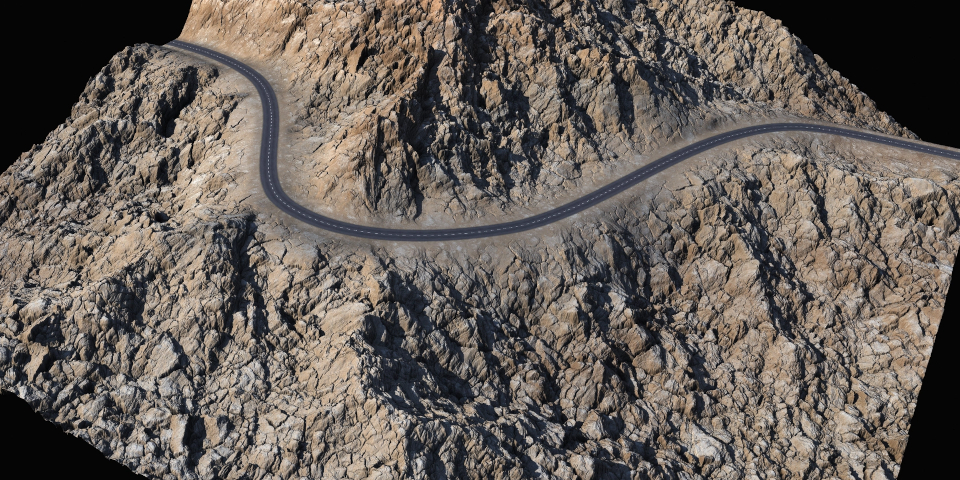
Gaea 3: new drawing tools for creating roads and rivers
Features planned for Gaea 3 include a new set of vector tools for drawing land forms more precisely: both natural features like rivers and man-made features like roads.
Gaea’s drawing tools, for creating shapes and masks, get a broader overhaul, with the option to combine vector and brush modes, and toggle reference images on a transparent overlay.
New options for sand, snow and river simulation
Gaea 3 will also add a range of new simulation capabilities to the software, including a sand solver capable of simulating large landforms like dune systems.
A new river simulation model combines manual and procedural approaches to shaping the course of rivers, automatically generating meanders around a user-created guide spline.
The update will also introduce “several advanced tools” for snow simulation.
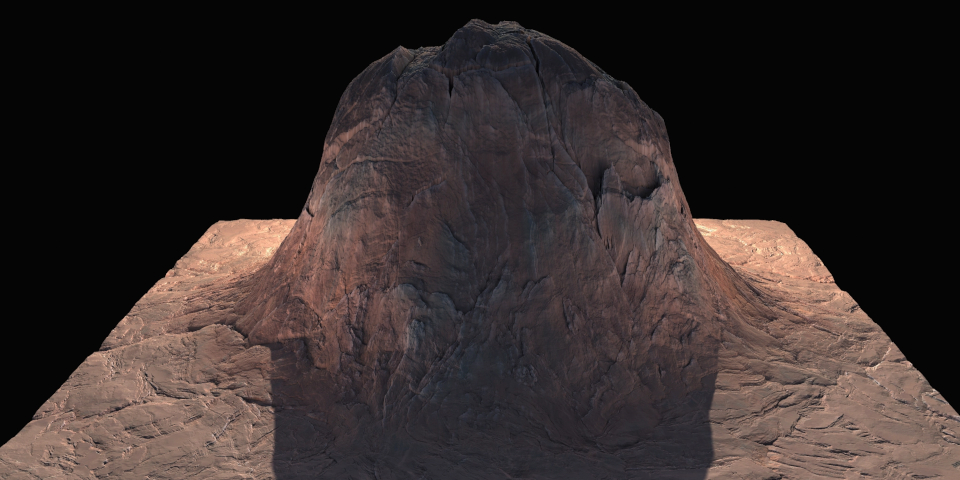
‘2.7D’ displacement and more detailed texture baking
The software’s handling of displacement will also be overhauled, although there isn’t currently a lot of detail about the “revolutionary new 2.7D displacement system”.
Gaea’s renderer is also being updated with a new large-scale GI model capable of baking and exporting “extremely fine detail … far beyond what conventional renderers can achieve”.
Workflow, UI and pipeline integration improvements
Workflow improvements include progressive previews of terrain, with the software generating a low-resolution version of the terrain that refines progressively as you work.
There are also planned improvements to Mixer, Gaea’s system for combining color sources, and to visualization of masks, including the option to overlay multiple masks onto terrain.
UI changes include a globally available Command Bar for quick access to key tools, and a new HUD mode for displaying key properties in the viewport when working across multiple monitors.
There will also be new integration plugins for 3ds Max, Blender, Maya and Unity, alongside the existing plugins for Houdini and Unreal Engine.
Professional and Enterprise editions only: native USD and OCIO support
Users with Professional and Enterprise subscriptions will also get native support for Universal Scene Description, with users able to import and export terrains in USD format.
Gaea 3 will also support color management standard OpenColorIO (OCIO), making it possible for VFX artists to work in ACES color spaces.
Other Professional and Enterprise-only features will include built-in versioning for terrain, and a SDK for developing custom tools and add-ons.
Being developed in parallel with the remaining 2.x updates
Gaea 3.0 is being developed in parallel with the Gaea 2.x releases, with some planned changes building on features that have yet to be released publicly.
In particular, a new set of ‘world space’ nodes for creating infinite worlds, rather than individual squares of terrain, build on the ‘God mode’ due in Gaea 2.4, currently scheduled for early 2026.
In its online FAQs about the release, QuadSpinner says that “every feature” on the Gaea 2 roadmap will be delivered “well before” Gaea 3 is released.
QuadSpinner also says that Gaea 3.0 will not be released until it has “community consensus is that it is production-ready”, stability having been an issue with the initial release of Gaea 2.0.
The update is backwards- but not forwards-compatible, so it will not be possible to load files saved in Gaea 3 in Gaea 2.x, but no changes are planned to system requirements or pricing.
Price, system requirements and release date
Gaea 3 is available for pre-order and is currently scheduled for release in mid-2026.
The current public release, Gaea 2.2, is compatible with Windows 10+. Integration plugins are available for Houdini and Unreal Engine.
For artists earning under $100,000/year, the Indie edition, which caps terrain resolution at 8K, costs $99.
The Professional and Enterprise editions, which provide support for building terrain at 256K resolution, plus a range of advanced features, cost $199 and $299.
There is also a free Community Edition for non-commercial use, which provides access to most of the key tools, but which caps build resolution at 1K.
Read more Gaea 3.0 on the QuadSpinner website
Have your say on this story by following CG Channel on Facebook, Instagram and X (formerly Twitter). As well as being able to comment on stories, followers of our social media accounts can see videos we don’t post on the site itself, including making-ofs for the latest VFX movies, animations, games cinematics and motion graphics projects.