
Maxon releases Redshift 2026.5
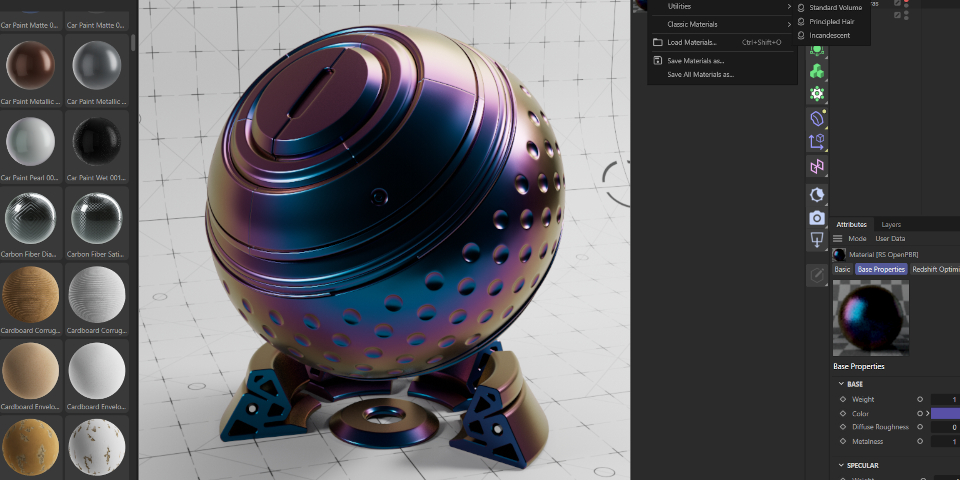
OpenPBR is now the default material in Redshift 2026.5 for Cinema 4D. The new open material standard will become the default in the other editions of the renderer in future updates.
Maxon has released Redshift 2026.5, the latest version of the GPU-accelerated renderer for VFX, motion graphics and visualization work.
The update extends the Texture Displacement system, makes the procedural night sky available in all editions of the renderer, and makes OpenPBR the default material for Cinema 4D users.
In addition, the software now natively supports hardware ray tracing on AMD GPUs, and CPU rendering on Windows on ARM devices like Microsoft’s Surface Pro.
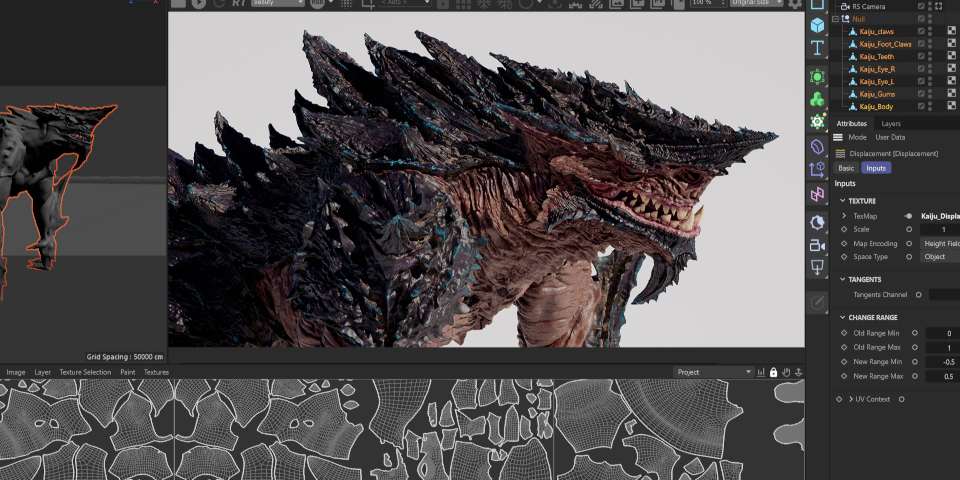
Texture Displacement now supports UDIMs
Redshift 2026.5 extends the new Texture Displacement system introduced in Redshift 2026.2 as an alternative to the existing Vertex Displacement.
Texture Displacement now supports UDIM UV layouts, and its Smart Bake feature now works for models without any UV maps at all – for example, assets that use triplanar texture projection.
Changes to individual plugins
In addition, the new procedural night sky system introduced in the Cinema 4D edition in Redshift 2026.4 is now available for all of the host applications.
For Cinema 4D users, the new OpenPBR material introduced last year in Redshift 2025.4 becomes the new default material.
Again, the change will roll out to the other host applications in future updates.
Support for hardware ray tracing on AMD GPUs
Redshift 2026.5 also introduces support for a number of new hardware platforms, including hardware ray tracing on AMD GPUs.
The renderer has supported AMD GPUs for several years, using AMD’s HIP (Heterogeneous-Compute Interface for Portability) framework, which lets developers create software that run on both NVIDIA and AMD GPUs from a single code base.
On top of that, Maxon has now implemented support for HIP RT, AMD’s GPU ray tracing library.
There’s no information in the release notes how this affects performance, but HIP RT resulted in a significant 10-30% speed boost when it was implemented in Blender’s Cycles renderer.
In Redshift 2025.6, HIP RT is still an experimental feature, so it has to be enabled manually.
It also requires a current-gen AMD GPU: the Radeon RX 9000 Series consumer cards, or its Radeon AI Pro R9000 Series workstation cards.
Support for CPU rendering on Windows on ARM
For CPU rendering, Redshift also now supports Qualcomm’s ARM-based Snapdragon processors.
That should improve performance and reduce memory use on the growing range of Copilot+ PCs – mainly laptops and 2-in-1 tablets like the Surface Pro – that use the Windows on Snapdragon platform.
Price and system requirements
Redshift 2026.5 is compatible with Windows 10+, glibc 2.28+ Linux and macOS 14.0+.
The integration plugins are compatible with 3ds Max 2018+, Cinema 4D 2023+, Houdini 19.0+, Katana 5.0+, Maya 2018+ (Maya 2022+ on Linux) and ZBrush 2023+.
The software is rental-only. Subscriptions cost $49/month or $289/year.
Read a full list of changes in Redshift 2026.5 on the Redshift forum
(Login required)
Have your say on this story by following CG Channel on Facebook, Instagram and X (formerly Twitter). As well as being able to comment on stories, followers of our social media accounts can see videos we don’t post on the site itself, including making-ofs for the latest VFX movies, animations, games cinematics and motion graphics projects.