
The Pixel Farm adds new point cloud toolset to PFTrack 26.05
The Pixel Farm has released PFTrack 26.05.19, the latest version of its 3D camera tracking app.
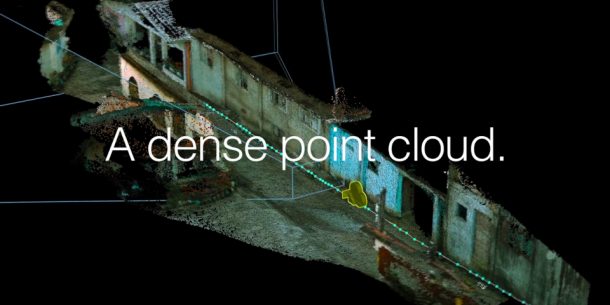
It’s a sizeable update, adding a new set of tools for generating dense point clouds from camera solves, and exporting them in USD format, or as COLMAP data for generating Gaussian Splats.
A powerful 3D camera tracking tool for VFX and visualization work
Originally released over two decades ago, PFTrack is a well-regarded matchmoving tool for visual effects and visualization work.
It has a node-based architecture, providing access to range of automated and manual tools for tracking cameras and objects, plus a built-in a lens distortion toolset.
Its scene-reconstruction tools include a native photogrammetry toolset for reconstructing scene geometry from still images or video.
New Hero Cloud node generates a point cloud from a single tracked camera
PFTrack 26.05.19 adds a set of new features for generating and exporting dense 3D point clouds, for use in both traditional and Gaussian Splatting workflows.
The core of the toolset is Hero Cloud, a new node that builds a dense 3D point cloud from a single solved camera “with no LiDAR or additional capture hardware required”.
Hero Cloud reconstructs depth from the movement of the camera through the scene, so it requires parallax in the shot: according to The Pixel Farm, most production footage has enough.
Export point clouds in FBX or USD format, or as COLMAP data
Once generated, point clouds can be exported in a variety of formats, making it possible to reconstruct the 3D environment from the tracked shot in other DCC software.
In USD files, PFTrack now exports dense point clouds with per-point normal and color data, not just spatial co-ordinates, for better integration with USD-capable tools like Maya and Houdini.
Handling of dense point clouds in exported FBX files is also now “more reliable”.
And for modern Gaussian Splat-based pipelines, PFTrack can now export in COLMAP format, for use in 3DGS generation tools like Postshot.
Convert point clouds to 3D meshes with the Photo Mesh node
PFTrack’s existing features have also been updated to support the new workflows.
Viewer windows now have an Active Camera viewport with the option to snap the camera pose to the active clip to verify Hero Cloud reconstructions visually against the source plate.
For users with Studio or Enterprise subscriptions, PFTrack’s Photo Mesh photogrammetry node can now convert Hero Cloud point clouds to triangular meshes.
Price and system requirements
PFTrack is compatible with Windows, macOS, and Rocky Linux.
For individual artists, node-locked Solo licenses provide the core functionality of PFTrack, but have limited pipeline integration options. They cost £699 (around $940).
Floating studio licenses cost £1,699 (around $2,286). Enterprise licenses are priced on enquiry. You can find a feature comparison of the three editions in the online documentation.
Read a full list of new features in PFTrack 26.05.19 in the online changelog
Have your say on this story by following CG Channel on Facebook, Instagram and X (formerly Twitter). As well as being able to comment on stories, followers of our social media accounts can see videos we don’t post on the site itself, including making-ofs for the latest VFX movies, animations, games cinematics and motion graphics projects.