
V-Ray for Blender Update 3 now runs on Linux
Chaos has released V-Ray for Blender, Update 3 (V-Ray 7.30.20 for Blender), the latest update to the new version of its ray tracing renderer for Blender.
The release makes the software available for Linux as well as Windows and macOS, adds support for AMD GPU rendering, and introduces a V-Ray version of Blender’s Node Wrangler.
A new edition of V-Ray integrated directly inside Blender
Released last year, V-Ray 7 for Blender makes it possible for Blender users to render with V-Ray from the current version of the open-source 3D software.
Unlike the legacy plugin, which exported scenes to V-Ray Standalone, it integrates V-Ray directly inside Blender, with V-Ray available for interactive rendering in the 3D viewport.
Since then, Chaos has also released the free V-Ray for Blender Community Edition, which can be used on commercial projects, with some workflow restrictions.
Now supports Linux, and GPU rendering on AMD GPUs
V-Ray for Blender, Update 3 (it’s actually version 7.30.20, since version 7.3 was the Community Edition itself) features a number of major structural changes.
For a significant minority of users, the biggest will simply be that the software now runs on their system: V-Ray for Blender now supports Linux, as well as Windows and macOS.
In addition, V-Ray GPU, the software’s hybrid GPU/CPU render engine, now supports AMD GPUs as well as NVIDIA and Apple Silicon processors.
That makes Blender the second edition of V-Ray to support AMD GPU rendering, Chaos having rolled out the functionality earlier this year in V-Ray for 3ds Max.
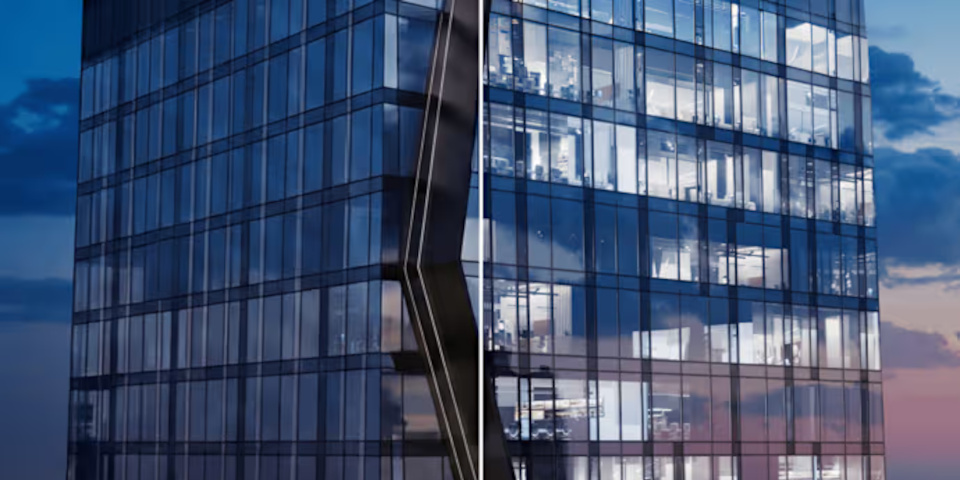
New features: parallax interiors and a native Node Wrangler
New features include support for parallax interiors, making it possible to add the illusion of interior depth to rendered buildings without the need to create any actual internal geometry.
When applied to a window on the exterior facade of a bulding, the new Parallax texture gives the illusion of a 3D interior behind it.
Workflow improvements include the V-Ray Node Wrangler, a native equivalent to Blender’s own Node Wrangler.
That makes it possible to manipulate Shader, Object and World nodes using the same keyboard shortcuts as in Blender itself.
Smaller changes include support for light cache denoising, the ability to add toon outlines from materials, and the ability to export geometry to .vrmesh (V-Ray Proxy) files.
Price, system requirements and release dates
V-Ray for Blender Update 3 is compatible with Blender 4.5+ on Windows 10+, Linux and macOS 11.0+. It supports GPU rendering with AMD, Apple Silicon and NVIDIA GPUs.
The V-Ray for Blender Community Edition is free, with some resolution and feature limitations.
Full V-Ray for Blender subscriptions include a named-user license of V-Ray for Blender, the Chaos Cosmos asset library and Chaos Cloud rendering, and cost $33/month or $199/year.
V-Ray for Blender is also available through standard V-Ray subscriptions, which provide access to all of the other current V-Ray integrations, plus a range of other tools and services.
Read an overview of the new features in V-Ray for Blender Update 3 on Chaos’s blog
Read a list of new features in V-Ray for Blender Update 3 in the online documentation
Have your say on this story by following CG Channel on Facebook, Instagram and X (formerly Twitter). As well as being able to comment on stories, followers of our social media accounts can see videos we don’t post on the site itself, including making-ofs for the latest VFX movies, animations, games cinematics and motion graphics projects.