
Chaos reinstates support for AMD GPUs in V-Ray
Chaos has reinstated support for GPU rendering on AMD hardware in V-Ray, its production renderer for VFX, motion graphics and architectural visualization.
The firm has just implemented AMD’s HIP framework in V-Ray 7 Update 3 for 3ds Max, making it the first new version of V-Ray for eight years to properly support AMD GPUs for rendering.
According to Chaos, AMD GPUs offer “competitive” performance in its internal tests, and actually outperform equivalent NVIDIA cards on scenes with large out-of-core textures.
Support for HIP will now roll out in other editions of V-Ray, including V-Ray for Blender.
V-Ray GPU: now supports AMD GPUs via HIP
V-Ray 7 Update 3 for 3ds Max reinstates support for AMD GPUs inside V-Ray GPU, the software’s hybrid GPU/CPU render engine.
V-Ray GPU used to support AMD hardware via the cross-platform OpenCL graphics API, but that was wound down with the release of V-Ray Next in 2018, making V-Ray GPU effectively a NVIDIA-only renderer.
In V-Ray 7 Update 3, support has for AMD GPUs has been reinstated via AMD’s HIP (Heterogeneous-Compute Interface for Portability) framework.
HIP – also used in Redshift and Blender’s Cycles renderer – lets developers create software that run on both NVIDIA and AMD GPUs from a single code base.
HIP is now available as a render backend in V-Ray for 3ds Max, alongside the NVIDIA-only CUDA and RTX modes.

Juan, Ian Spriggs’ 3D portrait, rendered in with V-Ray GPU on an AMD Radeon RX 9070 XT.
How does V-Ray GPU performance compare between AMD and NVIDIA GPUs?
In a detailed blog post about AMD support in V-Ray GPU, Chaos Senior Product Manager Muhammed Hamed describes the results on AMD GPUs as “encouraging”.
Performance is “solid overall”, and “most” scenes render correctly and match expected output.
Hamed lists render times for 10 test scenes on AMD and NVIDIA’s current flagship 16GB consumer GPUs, the AMD Radeon RX 9070 XT and the NVIDIA GeForce RTX 5080.
The Radeon RX 9070 XT provided “competitive performance”, although it was slower than the GeForce RTX 5080 in 9 of the 10 scenes tested when the 5080 was using the CUDA backend.
In addition, most NVIDIA users use RTX mode to enable hardware ray tracing, whereas support for the AMD equivalent, HIP RT, is currently “still a work in progress” in V-Ray GPU.
In RTX mode, the GeForce RTX 5080 outperformed the Radeon RX 9070 XT on all 10 of the test scenes, completing the renders between 1.3x and 2.0x faster.
What about price-performance ratio?
What makes AMD GPUs a more interesting proposition for V-Ray users is price-performance.
The GeForce RTX 5080 is roughly twice the price of the Radeon RX 9070 XT – at launch, the MSRPs were $999 and $599, and in practice, on sites like Newegg, cards currently sell for around $1,500 and $750 respectively.
With street prices changing so rapidly, it isn’t really meaningful to provide specific current price-performance figures for the two cards.
However, as Jason Lewis noted in our recent review of the GeForce RTX 5080, bang-for-your-buck is an important factor to consider when choosing a new GPU.
How does out-of-core rendering affect relative performace?
In addition, AMD GPUs may actually outperform their NVIDIA counterparts on very large scenes, such as city-scale architectural visualization scenes, or ultra-detailed 3D characters.
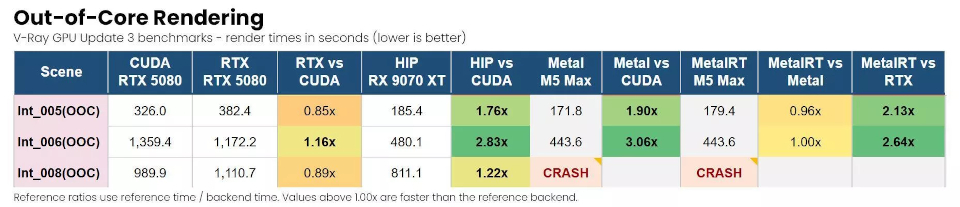
According to Chaos’s blog post, out-of-core rendering – rendering scenes larger than will fit into GPU memory – is “where the AMD story becomes especially interesting”.
When V-Ray GPU’s ‘Use System Memory for Textures’ was enabled, the Radeon RX 9070 XT outperformed the GeForce RTX 5080 on all three of the large scenes tested, even when using the RTX backend.
One scene rendered over 2.4x faster on the Radeon RX 9070 XT using HIP mode than the GeForce RTX 5080 using RTX mode.
Which AMD GPUs does V-Ray support for GPU rendering?
On 3ds Max, the HIP backend is supported on RDNA 2 GPUs and newer, which includes cards up to five years old: you can find a full list of supported hardware in Chaos’s blog post.
However, for best performance, Chaos recommends at least a RDNA 3 GPU: the Radeon RX 7000 Series consumer cards or Radeon Pro W7000 Series workstation cards.
Chaos tells us that support for AMD GPUs in V-Ray GPU is now due to roll out across the other editions of the renderer, including the new free V-Ray for Blender Community Edition.
GPU requirements are likely to be similar in the other host applications.
Read Chaos’s blog post announcing support for AMD hardware in V-Ray GPU via HIP
Full disclosure: in my life outside CG Channel as a freelance technical writer, I have worked on promotional material for AMD on HIP support in V-Ray GPU.
Have your say on this story by following CG Channel on Facebook, Instagram and X (formerly Twitter). As well as being able to comment on stories, followers of our social media accounts can see videos we don’t post on the site itself, including making-ofs for the latest VFX movies, animations, games cinematics and motion graphics projects.