
Adobe releases Substance 3D Designer 16.0

Originally posted on 10 March 2026 for the preview, and updated for the final release.
Adobe has released Substance 3D Designer 16.0, the latest version of its material-authoring software for game development, visual effects and visualization work.
The release revamps the software’s Shape Splatter nodes to scatter 3D rather than 2D shapes, and introduces a new set of nodes for creating custom 3D forms using Signed Distance Fields.
Adobe has also switched Substance 3D Designer to the new OpenPBR material standard, introduced two new render engines, and removed MDL materials and the old Iray renderer.
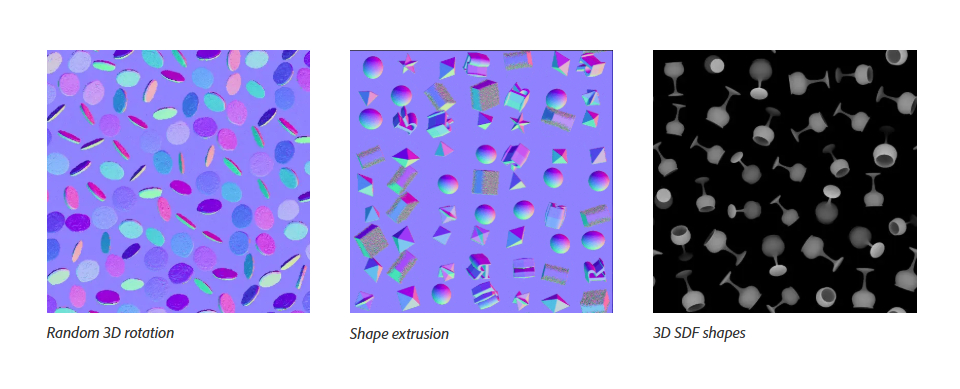
Revamped Shape Splatter node scatters 3D shapes, not 2D shapes
Substance 3D Designer 16.0 revamps the Shape Splatter node, used for tasks like scattering ground debris over terrain.
The original version scatters 2D shapes, but Shape Splatter v2 scatters 3D shapes – either simple 3D primitives, or custom shapes.
The shapes are scattered individually in real time, providing per-instance control over properties like orientation and size, generating more believably varied results.
The new node also supports new scattering methods, including Poisson distribution; and shape distribution is now collisionless by default, preventing unwanted overlaps between shapes.
Custom shapes can be defined as Signed Distance Fields (SDFs), or as 2D images – either provided individually, or packed into a Grid Atlas – which are then used to extrude a height map.
Companion nodes project textures onto the scattered shapes, or generate masks from them.

New nodes for creating and modifying SDF shapes
To support Shape Splatter v2, Substance 3D Designer 16.0 also introduces a new set of nodes for generating and editing SDFs.
The include 20 nodes for generating 3D primitives – the usual set of geometric forms, plus a readymade rock shape.
The primitives can then be modified using transforms – including Bend, Flip, Offset, Scale, Rotate and Twist – or by combining them using Boolean operations.
A set of material nodes makes it possible to set “basic material attributes” for the SDF shapes, like color, metalness, roughness and material ID.
For visualizing the results, a new 3D Viewer node renders the 3D shapes, and includes a customizable camera and environment light.
The new toolset is Adobe’s first foray into generating 3D forms inside Substance 3D Designer – albeit in a more focused way – since the procedural geometry system was removed in 2023.
Now supports OpenPBR: MDL materials and the Iray renderer removed
Substance 3D Designer 16.0 also moves the software to OpenPBR.
The new open material standard supersedes both the old Adobe Standard Material and Autodesk Standard Surface, and is increasingly being adopted in other DCC applications.
OpenPBR is now the default for the 3D view, and is supported in the Substance 3D Designer’s render engines: the OpenGL renderer, plus the newer Rasterizer and GPU Pathracer engines.
The old Iray renderer and MDL material graphs have been removed: Iray deprecated in favor of the GPU Pathtracer, and MDL materials in favor of MaterialX, of which OpenPBR is a subproject.
Benefits of the switch to OpenPBR include support for more shading effects, including thin film effects like surface iridescence.
All of the effects are also now available in OpenGL and raster renders – both the new effects made possible by OpenPBR materials, and existing effects, “including refraction at long last”.
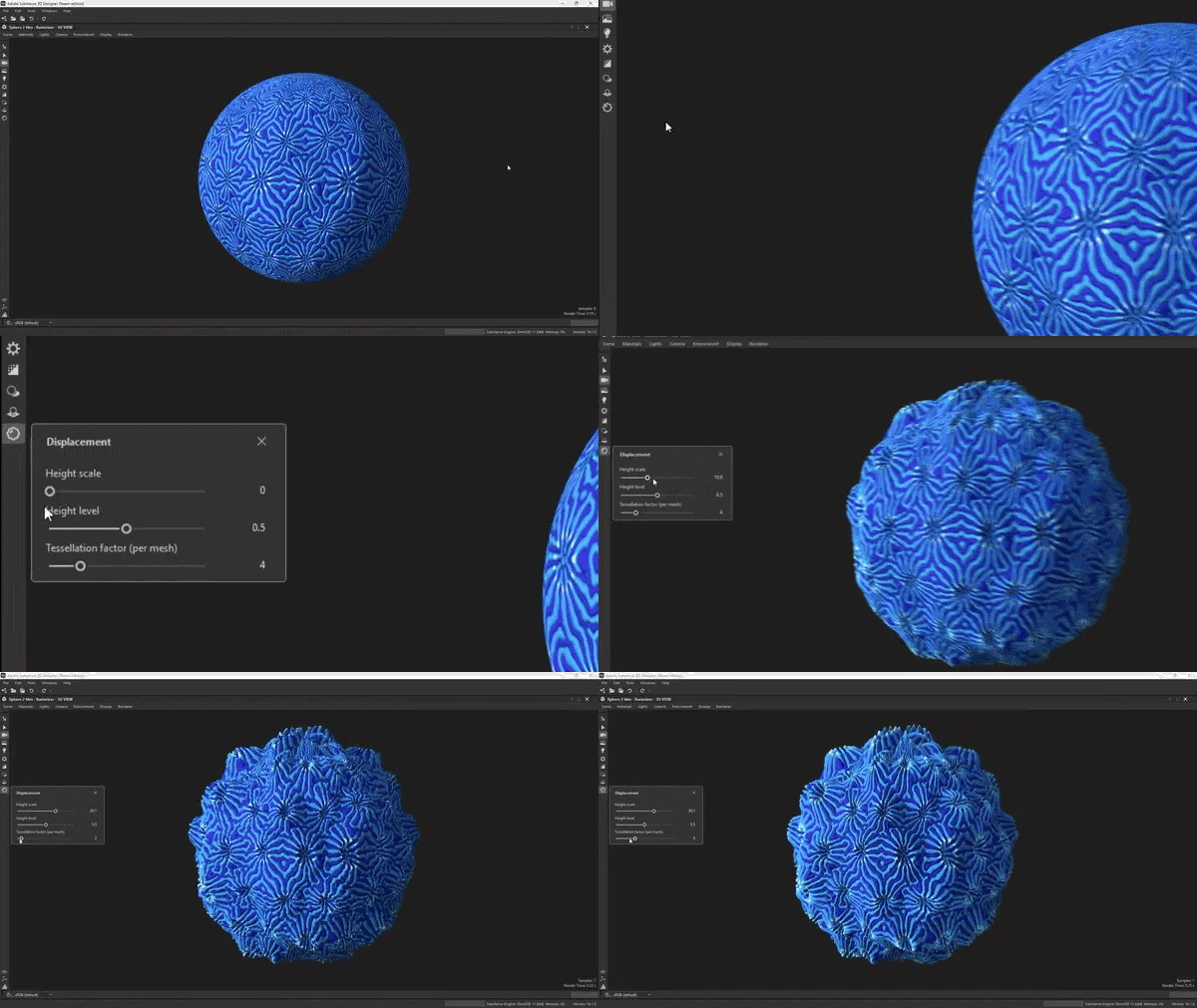
Other changes: better displacement UI, VFX Reference Platform 2026 support
Workflow improvements include a new Displacement pop-up in the 3D View toolbar, making it easier to adjust displacement and tessellation in the 3D View.
The software has also been updated to the current CY2026 spec for VFX Reference Platform.
Adobe’s blog post previewing the update also mentioned new ribbon graph samples that can be used as the basis for custom tools based on the new Ribbon path system in Substance 3D Painter, Adobe’s 3D painting software, but there is no mention of them in the release notes.
Price, system requirements and release date
Substance 3D Designer 16.0 is compatible with Windows 11, RHEL 8/9 and Ubuntu 22.04 Linux and macOS 14.0+.
It is available as a $199.99 perpetual license on Steam, or via Adobe’s 3D and AR subscriptions.
Substance 3D Texturing subscriptions cost $24.99/month or $249.99/year; Substance 3D Collection subscriptions cost $59.99/month or $599.99/year.
Read a full list of new features in Substance 3D Designer 16.0 in the online release notes
Have your say on this story by following CG Channel on Facebook, Instagram and X (formerly Twitter). As well as being able to comment on stories, followers of our social media accounts can see videos we don’t post on the site itself, including making-ofs for the latest VFX movies, animations, games cinematics and motion graphics projects.