
10 things CG artists need to know about Unreal Engine 6
Epic Games held Unreal Fest 2026, its annual user conference, in Chicago this week.
While the keynote covered a lot of ground, from the release of Unreal Engine 5.8 to the latest updates to Fortnite, the centerpiece was undoubtedly Unreal Engine 6, the next major version of the game engine and industry-changing real-time content creation tool.
Epic had teased the fact that UE6 was coming in a Rocket League trailer last month, a glowing ‘6’ popping up alongside the Unreal Engine logo at the end of video, but – beyond the fact that it was in development – that was all that we knew.
Wednesday’s keynote filled in some of the missing details.
Compared to the reveal of Unreal Engine 5 in 2020, with its focus on eye-catching new features like Nanite and Lumen, and gorgeous accompanying demo, it wasn’t a showy affair: there were no live demos of UE6, and almost no mention of its graphic capabilities.
Instead, the focus was on programming and distribution: the changes that Epic is making under the hood of the engine, and the business case for doing so.
As Epic put it in its accompanying blog post on Unreal Engine 6: “UE5 reinvented how we build worlds. UE6 is about evolving how we ship and operate them.”
But as so many parts of the industry now rely on Unreal Engine – not just games, but VFX, virtual production, architectural visualization and motion graphics, all of which now have dedicated toolsets added or developed throughout the UE5 release cycle – any change to the software affects the day-to-day work of close to a million users worldwide.
For that reason, we felt it was worthwhile going into the announcements in more detail, so below, you can find 10 things we think that CG artists should know about Unreal Engine 6.
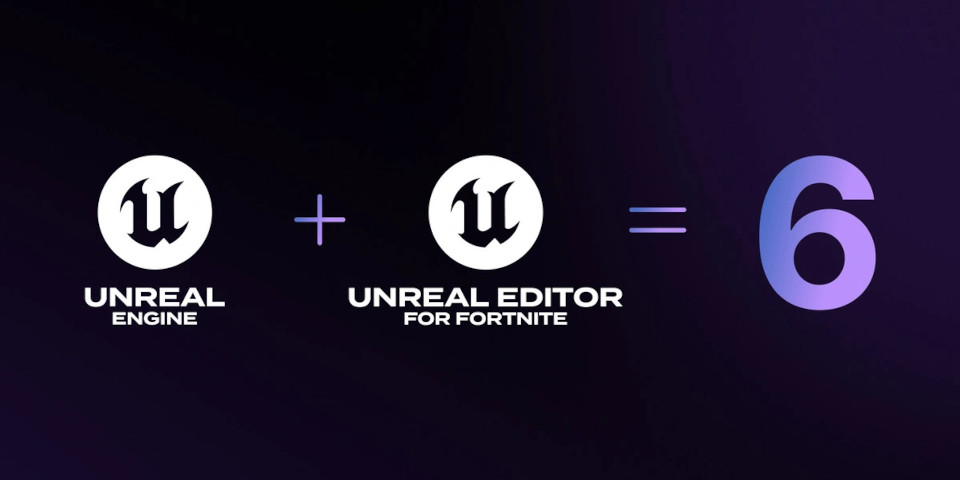
1. UE6 will unify the Unreal Editor and Unreal Editor for Fortnite
There are currently two ways create content in Unreal: by using the classic Unreal Editor, for developing standalone games and offline content, or Unreal Editor for Fortnite, for creating content for the multiplayer online game.
Both versions have features the other doesn’t – which, as Epic CEO Tim Sweeney put it in the keynote, is “kind of awkward”.
UE6 will unify the two, making it possible to create a game “you can ship everywhere, including the console stores, PC stores, mobile stores and [into] the Fortnite ecosystem.”
From Epic’s point of view, it probably doesn’t hurt not to have to maintain two separate development streams, either, particularly with player numbers in Fortnite – still massively popular, but probably now past its peak – currently declining.
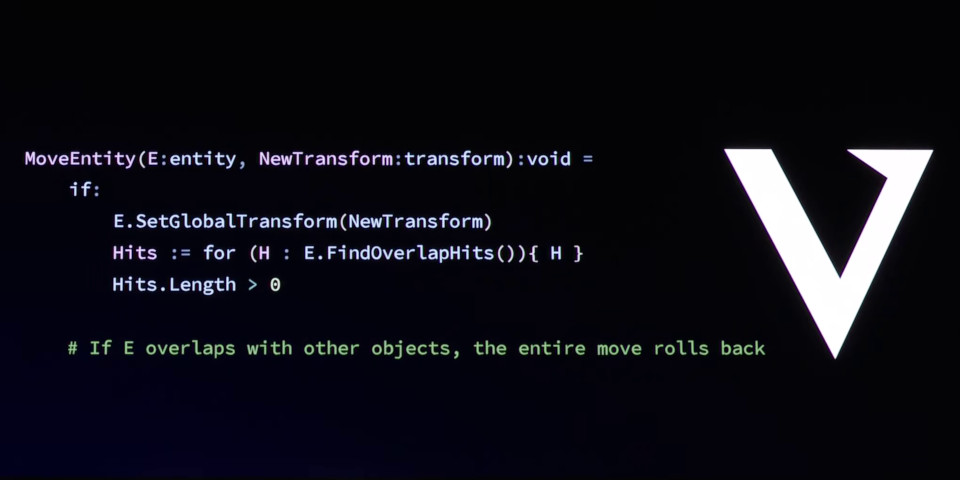
2. UE6 will be built on Verse, UEFN’s programming language
While being able to use a single version of Unreal to create games for any platform doesn’t benefit artists outside the game industry, Epic’s decision to unify the two editors does have consequences for them, as UE6 will be built on Verse, UEFN’s programming language.
A “next-generation language” that “draws from functional, logic, and imperative languages”, and which “should feel immediately familiar to anyone who has worked with … Python or C#”, Verse has a number of advantages for creating large-scale persistent game worlds.
For non-programmers, the technical details are quite gnarly – if you’re interested, Epic EVP for Development Marcus Wassmer does a deeper dive in the keynote – but one interesting aspect of the change is that in UE6, multiplayer game code can be written as if it were running on a single machine.
While scaling a game to run on multiple servers currently requires fundamental changes to game architecture, with UE6, “we intend to take the existing single-threaded-style Verse game code, then distribute it across multiple servers automatically”.
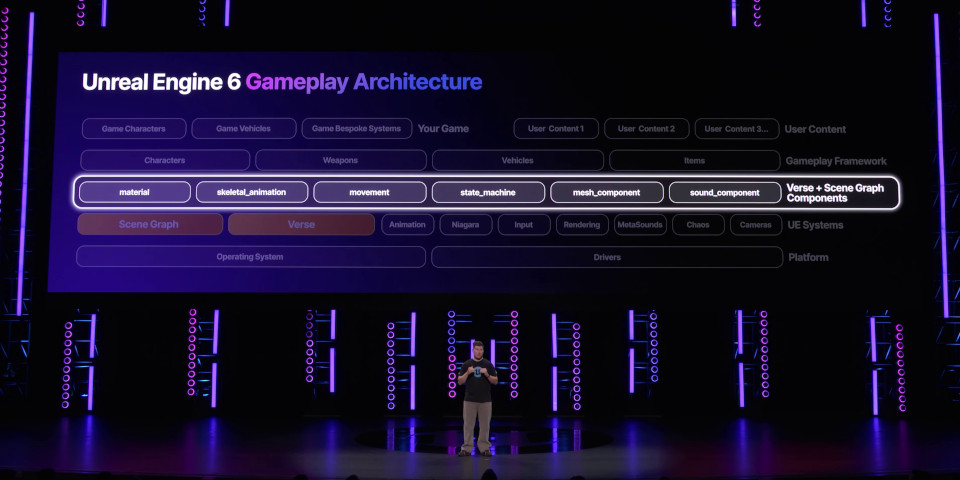
3. UE6 will include a new Verse Scene Graph
For building environments, UE6 will also introduce the Verse Scene Graph, a “modern game component framework with full support for prefab-style workflows and composition”.
Again, you can find a deeper dive in the keynote, as Kurtis Schmidt, Epic Games’ Technical Director for Framework, explores how Verse fits into the wider UE6 architecture.
“Each material, mesh, and Niagara system you author becomes a derived type of Verse class, with a statically validatable API. This lets us use the Verse compiler to validate all data in a unified manner. For example, if you change a parameter in a particle system, you’ll immediately know where in code needs to be updated to match.”
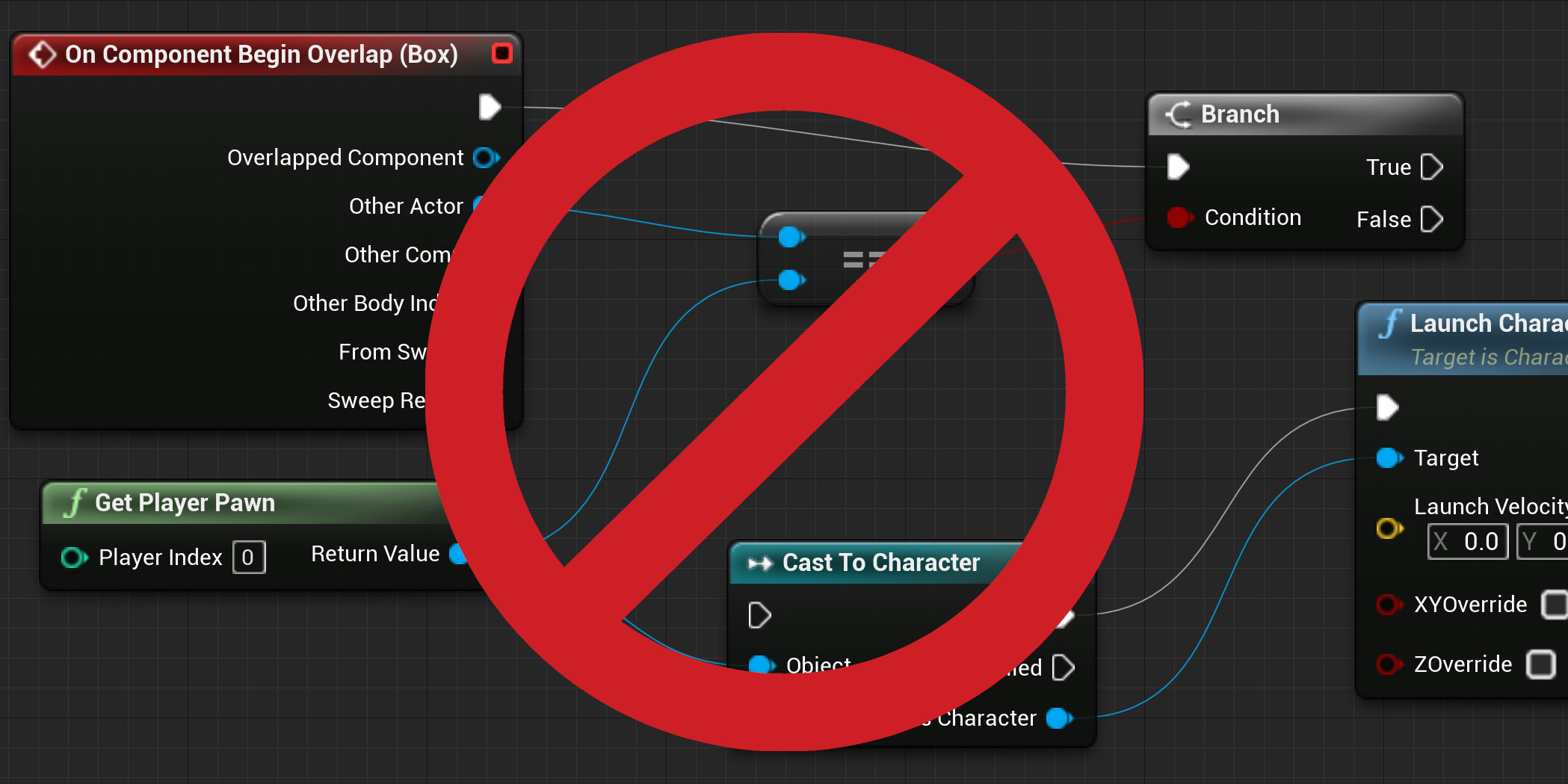
4. UE6 will deprecate Blueprints
Working directly with code seems likely to become more important in Unreal Engine 6, since Blueprints, Unreal’s visual scripting system, is being removed.
While Blueprints and Actors will be available in “early versions” of UE6, they will be deprecated “when the new framework is sufficiently mature”.
Although there will be conversion tools to move existing projects from one framework to the other, the loss of Blueprints has proven to be one of the most controversial parts of this week’s announcements, as you can see from the comments on the Unreal Engine forum.
Users point out that Blueprints provide a way for artists and designers from non-technical backgrounds to create content that works in-game, without the need to involve a coder.
While it’s possible that UE6 will have a new visual scripting system, Blueprints provide a well-established workflow, with over a decade’s worth of learning material available online.
As one comment puts it: “Blueprint is not just another feature. It is one of the core reasons I chose Unreal Engine in the first place. It allowed me to focus on building worlds [and] designing gameplay without having to spend years becoming a traditional programmer.”
5. UE6 will make it easier to port content between projects
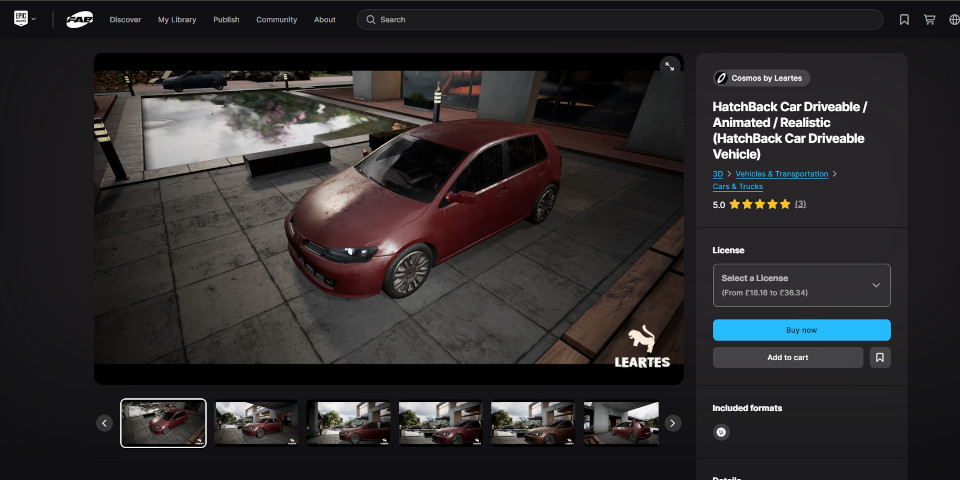
Workflow changes aside, one of the proposed benefits of the Verse Scene Graph – which is supplemented by higher-level frameworks for creating “common game systems” like characters and vehicles – is that content it creates will be easier to move between projects.
As well as streamlining workflows within studios, Epic says that the change will extend the functionality of the stock content available on online marketplaces like Fab.
“Imagine grabbing a car from Fab,” said Kurtis Schmidt. “Instead of simply getting a skeletal mesh and some animations like you might today, you get a fully working Verse module for a car that functions across all of your games.”
6. Generative AI will play a big role in UE6 workflows
Another important – and, for some artists, contentious – part of the keynote was a discussion of the role that generative AI will play in Unreal Engine 6 workflows.
Predictably, Epic thinks that the games of the near future will still be created using game engines, rather than promptable world models like Google DeepMind’s Genie 3.
However, generative AI still plays a prominent role in Epic’s plans, if not necessarily to create in-game content from scratch, then at least to refine it.
According to Marcus Wassmer: “AI-assisted game creation will tighten iteration loops” speeding up “time-consuming manual [tasks like setting up] character rigs, particle systems, skinning bone weights [and] adjusting lighting”.
Unlike Unity, there was no suggestion that Epic would operate its own AI services: instead, the focus was on integrating UE6 with an ecosystem of external AI models.
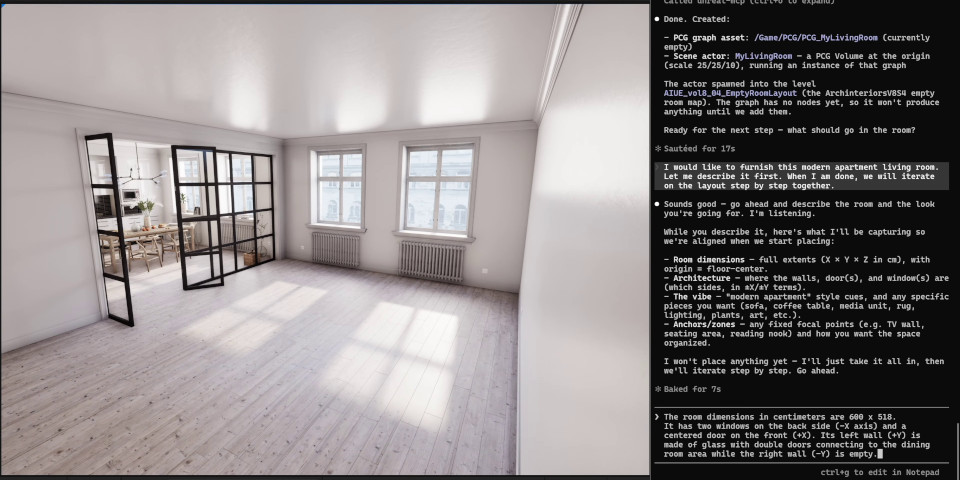
Epic has already begun to build bridges to third-party AI tools, with the new MCP server in Unreal Engine 5.8 making it possible to use LLMs like Claude or Gemini to control Unreal Engine using natural-language commands.
Epic also showed off upcoming tools – due early next year, so presumably before UE6 itself – for bringing diffusion models into Unreal Engine, making it possible to go beyond text prompts when creating offline content like style frames or architectural visualizations, and use information from a 3D scene, like depth data and normal maps, as inputs for AI.
Unreal Engine 6 itself will build on both workflows.
“For UE6, we see LLMs, generative AI models, and [AI coding tools like] Codex playing a central role in building your content faster,” said Wassmer.

7. Epic is open-sourcing key technologies used in UE6
As part of its vision of making the content it creates more portable between platforms, Epic is also promoting the use of open standards within Unreal Engine 6.
“Where existing standards such as glTF or USD are capable of fulfilling UE6’s needs, we will make them first-class formats within the engine,” said Marcus Wassmer. “Where a standard doesn’t yet exist, we will open up Unreal’s own systems as open specifications with Verse APIs [and] asset conventions that any engine, tool, or studio can implement against.”
Epic has already begun that process, announcing during the keynote that Lore, UEFN’s version control system, is now available on GitHub under a MIT license.
Previously known as Unreal Revision Control, Lore is intended as a more game-dev-specific alternative to version control systems like Git, scaling from a “zero-config, single-server setup for small teams” to “multi-region, multi-million-user deployments” like UEFN itself.
Epic has already begun moving to Lore as its own primary internal version control system, and plans to be using it fully by the time Unreal Engine 6 launches.
8. UE6 will be in early access in 2027, with a stable release in 2029
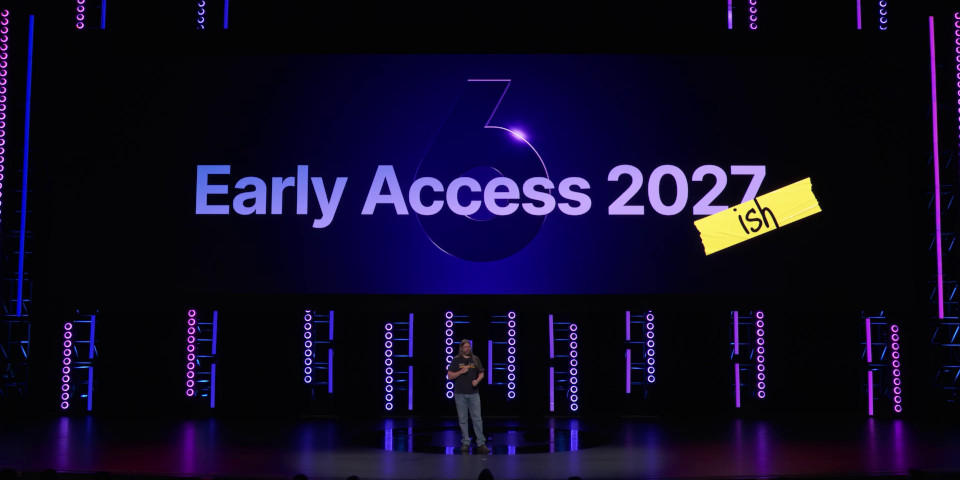
So when will that launch actually be? During the keynote, Epic said that it plans to release UE6 in early access at the end of 2027, with a stable release 12-18 months later.
While those dates were caveated with an emphatic “ish”, Epic has managed shorter timescales in the past: UE5 took under two years to go from reveal to stable release.
Epic has already opened a UE6 development stream on GitHub: not as “any kind of alpha”, but “to be transparent with where we’re going”, so users can see changes ahead of release.
9. UE6 will be compatibility-breaking
As you would expect, Unreal Engine 6 is compatibility-breaking, with Epic “taking the opportunity to make big architectural changes … that we wouldn’t in a normal point release.”
Users should “expect a similar upgrade path from UE5 to UE6 as we had for UE4 to UE5”, with Epic providing at least some tools to convert existing projects to UE6.
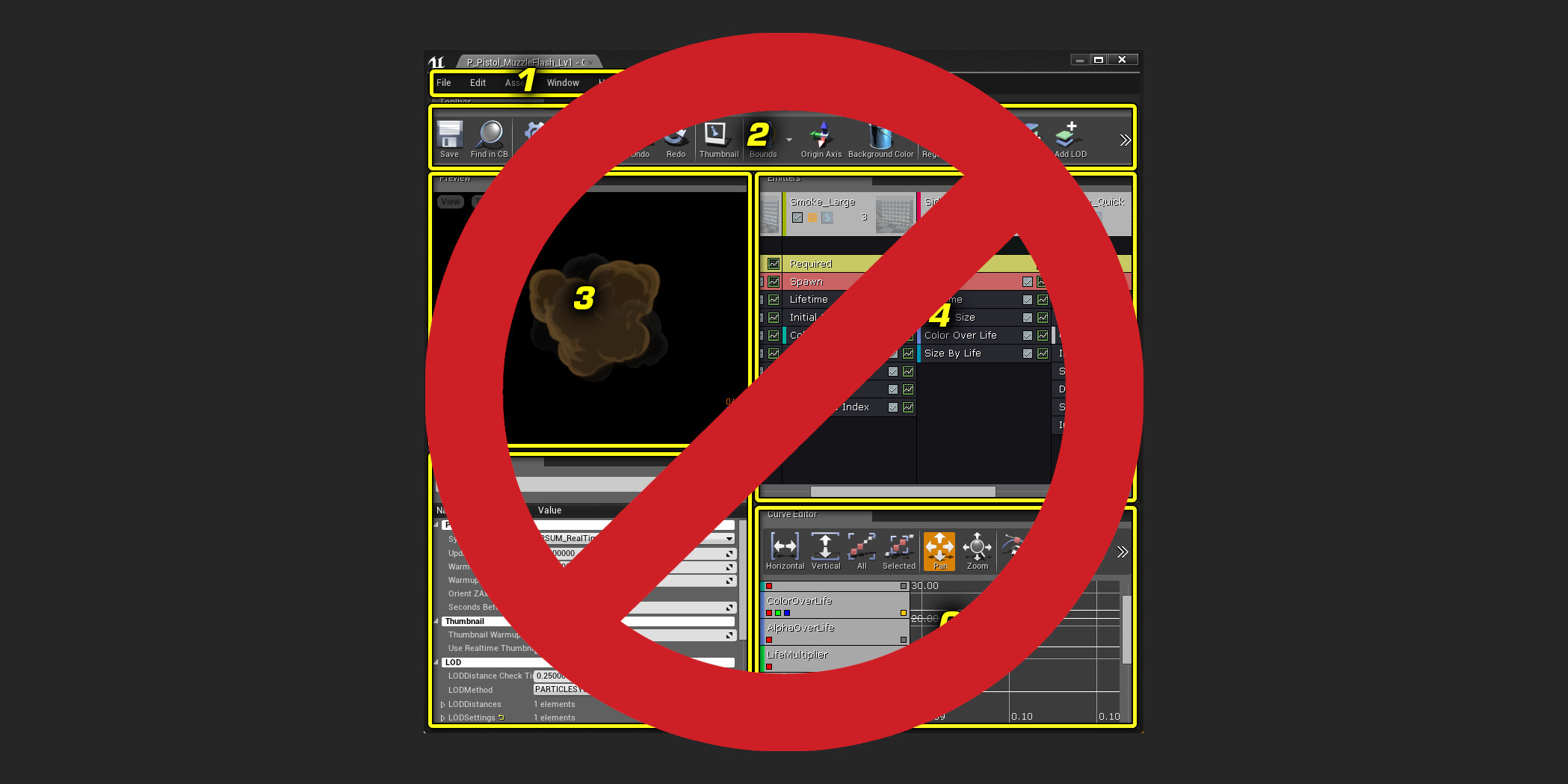
However, UE6 will include “all of the mainline UE5 tech” – at least in the initial releases – with the exception of Cascade.
The legacy particle system was deprecated in UE5, and is now due to be removed entirely.

10. There won’t be an Unreal Engine 5.9 – unless there is
Finally, one of the more surprising announcements from the keynote is that Epic isn’t currently planning another official UE5 release after Unreal Engine 5.8.
That potentially leaves a three-year gap until the stable release of Unreal Engine 6.0.
With a number of important UE5 systems – both developer features like incremental cooking, and artist features like Control Rig physics – still not officially production-ready, and Unreal Engine 5.8 itself introducing major new experimental features like Mesh Terrain, that seems a long time to leave those toolsets in limbo.
However, Epic also noted that it is “reserving the option to release a 5.9, if needed”, so we wouldn’t be entirely surprised if that changes.
Read Epic Games’ blog post on the road to Unreal Engine 6
Have your say on this story by following CG Channel on Facebook, Instagram and X (formerly Twitter). As well as being able to comment on stories, followers of our social media accounts can see videos we don’t post on the site itself, including making-ofs for the latest VFX movies, animations, games cinematics and motion graphics projects.