
NVIDIA unveils DLSS 5
NVIDIA has unveiled DLSS 5, the next major version of its suite of neural rendering technologies designed to boost viewport frame rates in games and CG software.
The update promises to deliver “a new level of photoreal computer graphics previously only achieved in Hollywood visual effects” by enhancing viewport renders with generative AI.
NVIDIA describes the release, due to become available to its users this Fall, as “the company’s most significant breakthrough in computer graphics since the debut of real-time ray tracing”.
Below, we’ve summarized the implications for games artists and developers, and for users of other CG applications that integrate DLSS.
DLSS: AI tech to improve viewport frame rates in games and CG software
First introduced in 2019, DLSS (Deep Learning Super Sampling) is a set of ‘neural rendering’ technologies that use AI to improve frame rates and image quality in real-time applications.
The initial version was primarily an image-upscaling system, enabling software to render the screen at lower resolution, then upscale the result to the actual resolution of the user’s monitor.
Later releases introduced frame-generation algorithms, generating additional frames in between conventionally rendered frames, further increasing viewport frame rates.
Although primarily targeted at games, and game engines like Unity and Unreal Engine, DLSS is also supported in a range of CG software, including Chaos Vantage, D5 Render and Twinmotion.
Unlike the AMD equivalent, FSR (FidelityFX Super Resolution), or Intel’s XeSS (Xe Super Sampling), DLSS doesn’t support other manufacturer’s hardware, and requires a NVIDIA GPU.
How does the AI model in DLSS 5 work?
To that, DLSS 5 introduces a new AI model that uses pixel color values and motion vectors as inputs to apply new lighting and material effects to rendered frames.
The result is a hybrid between conventional real-time graphics and generated video, “blending hand-crafted rendering with generative AI” to add details not otherwise present in the frame.
According to NVIDIA, unlike traditional generative video, the output of its AI model is deterministic and consistent from frame to frame.
The model also has a more specific focus, being “trained to understand complex scene semantics such as … hair, fabrics and skin, along with environmental lighting conditions”.
DLSS 5 will also provide “detailed controls” for intensity and color grading, plus masking options to control to which parts of the frame the AI is applied.
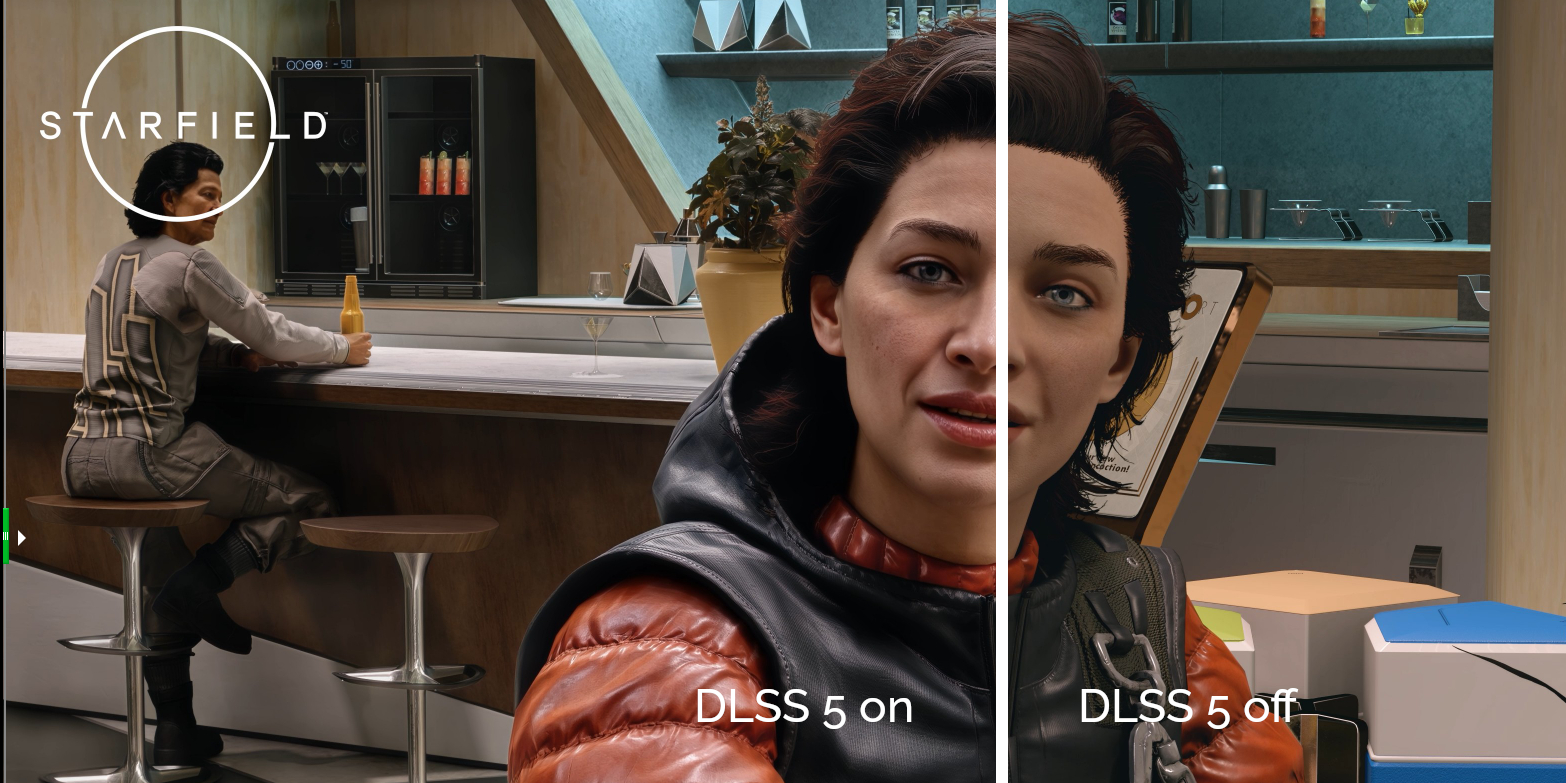
How does DLSS 5 affect the look of rendered frames?
NVIDIA’s blog post announcing DLSS 5 includes before-and-after comparisons for recent-ish games, including Resident Evil: Requiem and older titles like Hogwarts: Legacy.
They suggest that it increases contrast in lighting, particularly on characters’ faces, and goes some way towards mimicking complex material effects like subsurface scattering on skin.
The results are most noticeable in titles where the conventionally rendered image is less detailed, like Battlefield and EA Sports, but they’re pretty significant in all of the demos.
The modified output also seems to change details in the original render, as you might get with AI video enhancement tools.
It’s most visible in the images from EA Sports, where DLSS 5 changes the position of folds in the footballers’ shirts, and the positions of the background characters in the stadium.
How good is DLSS 5?
NVIDIA is certainly bigging up the release, with the launch materials including a quote from CEO Jensen Huang that “DLSS 5 is the GPT moment for graphics”.
Online, the reaction from gamers and artists has been mixed, with common criticisms being that DLSS 5 alters the look of characters’ faces too much, or that it makes them look ‘plastic’.
Digital Foundry, which had a hands-on demo of the four games shown in NVIDIA’s blog post, has an interesting article summarizing its initial reactions, concluding that despite “some screen-space errors”, DLSS 5 is the “real deal”. Other gaming sites have been less kind.
How much will DLSS 5 affect rendering performance?
While NVIDIA says that DLSS 5 runs in real time and up to 4K resolution, Digital Foundry suggests that that might require some pretty serious hardware, at least initially.
The site reports that the demo it saw required two top-of-the-range NVIDIA GeForce RTX 5090 GPUs, one to run the game, the other exclusively to run the DLSS 5 technology.
That isn’t a setup that most gamers – or indeed, many graphics professionals – will have, and one that, at current street prices, would set you back around $7,000 for the GPUs alone.
Which games will support DLSS 5?
As well as the games shown in the blog post, NVIDIA namechecks 12 other existing titles that will support DLSS 5, presumably before the official release later this year.
The firm also says that DLSS 5 will be “supported” by major developers and publishers, including Bethesda, Capcom, Tencent, Ubisoft and Warner Bros. Games.
What will DLSS 5 mean for games artists?
If widely adopted, DLSS 5 could change the way that games artists work, with developers using artists to create only relatively low-detail assets, then relying on the AI to enhance them.
Similar workflows are already being adopted offline in visual effects pipelines.
Digital Foundry touches on this in its article, commenting that NVIDIA is using machine learning “to ‘bypass’ years of hardware evolution and software development” in photorealistic graphics.
What will DLSS 5 mean for DCC software?
The AI model in DLSS 5 has presumably been trained on games graphics, so it isn’t clear how well it will transfer to DCC tools that integrate DLSS.
The focus on characters’ skin and hair would be less relevant to architectural visualization tools like D5 Render, although DLSS 5 does also enhance scene lighting.
However, D5 Render does have its own AI Enhancer – which also adds detail and rebalances lighting in renders – so there is some obvious crossover with DLSS 5.
A closer fit might be Vantage, Chaos’s real-time renderer for exploring large architectural visualization and VFX scenes.
Although it isn’t currently integrated into Vantage, Chaos has its own AI Enhancer, and one of its use cases is adding detail to people, like background characters in architectural renders.
Release dates
DLSS 5 is due to be available via the NVIDIA App in Fall 2026 for GeForce RTX 50 Series GPUs.
Read NVIDIA’s blog post announcing DLSS 5
Have your say on this story by following CG Channel on Facebook, Instagram and X (formerly Twitter). As well as being able to comment on stories, followers of our social media accounts can see videos we don’t post on the site itself, including making-ofs for the latest VFX movies, animations, games cinematics and motion graphics projects.