
Foundry releases Nuke 17.1
Originally posted on 2 July 2026 for the open beta, and updated for the final release.
Foundry has released Nuke 17.1, the latest update to its family of compositing apps.
Nuke itself gets updates to 3D Gaussian Splatting and USD workflows, including support for animated splats, the option to relight splats, and Hydra 2.0 support in the 3D viewer.
Nuke Studio, which adds timeline capabilities, gets updates to the Annotations system, the Contact Sheet and A/B comparisons.
Nuke, NukeX and Nuke Studio: support for animated Gaussian Splats and Splat relighting
Nuke 17.1 extends the major new toolset introduced in Nuke 17.0 itself: 3D Gaussian Splatting.
The previous release made it possible to import, manipulate and render 3DGS data, primarily as a way to incorporate scans of real-world locations as environments or set extensions.
To that, Nuke 17.1 adds support for animated Gaussian splats, as shown in the video above.
The new GeoSequencer node can process sequences of imported USD, PLY or SPLAT files, and output them as a time-sampled USDC file that can be manipulated by Nuke’s existing toolset.
The existing SplatRender node has been updated to support 2D rendering of Direct, Point, and Spot lights placed in the 3D system, making it possible to do “basic relighting” of splats.
It is also now possible to export Splats in SPLAT, SPZ and PLY format, as well as as USD files.
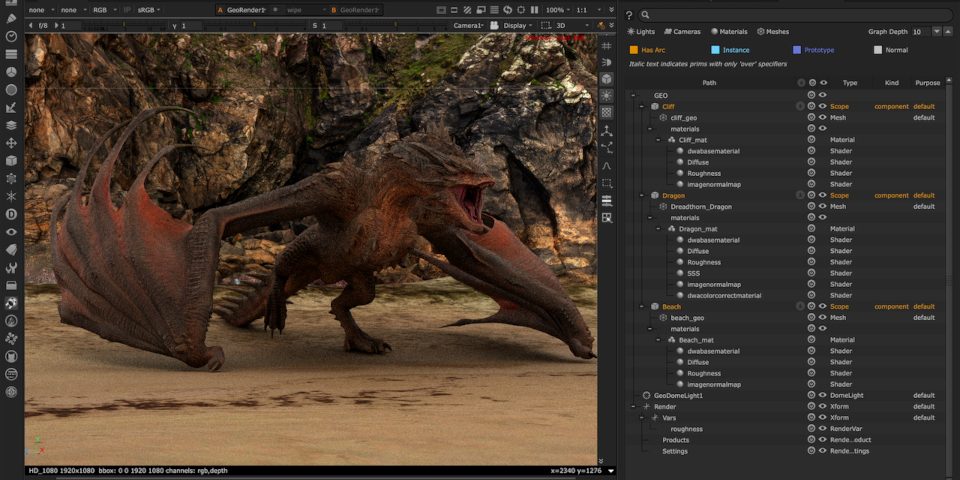
Nuke 17.1 adds support for Hydra 2.0 in the 3D Viewer and the new GeoRender node.
Nuke, NukeX and Nuke Studio: new USD workflows and Hydra 2.0 support
The update also introduces new non-destructive USD export workflows, making it possible to explicitly define sublayers, and export specific scene modifications as overs (sparse overrides).
The changes reduce the need to flatten scenes, improving round-tripping between departments or studios.
For flattened exports themselves, the GeoExport node now defaults to a new workflow in which frames are exported individually, then stitched into a single files, reducing memory usage.
The Hydra-based 3D viewer has been updated to Hydra 2.0, the current version of the USD rendering framework.
The change opens up new options for displaying a 3D scene when using the current HdStorm render delegate, including the option to preview individual AOVs, like depth and position.
It is also possible to preview other Hydra render delegates in the 3D Viewer, including RenderMan and MoonRay.
A new GeoRender node makes it possible to render a 3D scene using Hydra 2.0, to output the render passes available in a delegate directly to Nuke.
In addition, the ScanlineRender2 node and a “number of shaders” get new cutout controls to streamline the process of rendering cutouts and holdouts.
Nuke Studio: updates to Annotations and the Contact Sheet
In Nuke Studio, the new Annotations toolset introduced in the 17.0 update gets a Shapes tool, for marking up frames with geometric annotations: currently, rectangles and arrows.
It is optimized for mouse and trackpad users, with controls for shape color, width and opacity.
The Contact Sheet now works on a per-sequence basis, rather than being a single, manually managed tool.
The change brings a number of workflow improvements, including the option to load all visible timeline tracks with one click, and to switch between grid view and a single full-frame cell.
A new Compare Versions feature makes it possible to perform A/B comparisons without leaving the timeline, and supports the same comparison modes as the Viewer.
It is also now possible to burn in custom metadata and expressions as soft effects.
Price, system requirements and release date
Nuke 17.1 is compatible with Windows 11, Rocky Linux 9.0 and macOS 15.0+.
Nuke is rental-only. Annual subscriptions cost $3,839/year for Nuke, $5,219/year for NukeX, and $6,379/year for Nuke Studio. Nuke Render licenses cost $462/year, up $22/year.
Subscriptions to Nuke Indie, the feature- and resolution-limited commercial edition for artists earning under $100,000/year, cost $499/year.
Read an overview of new features in Nuke on the product website
Read a full list of changes in Nuke 17.1 in the online release notes
Have your say on this story by following CG Channel on Facebook, Instagram and X (formerly Twitter). As well as being able to comment on stories, followers of our social media accounts can see videos we don’t post on the site itself, including making-ofs for the latest VFX movies, animations, games cinematics and motion graphics projects.