
Insydium releases NeXus 2026.1 in beta
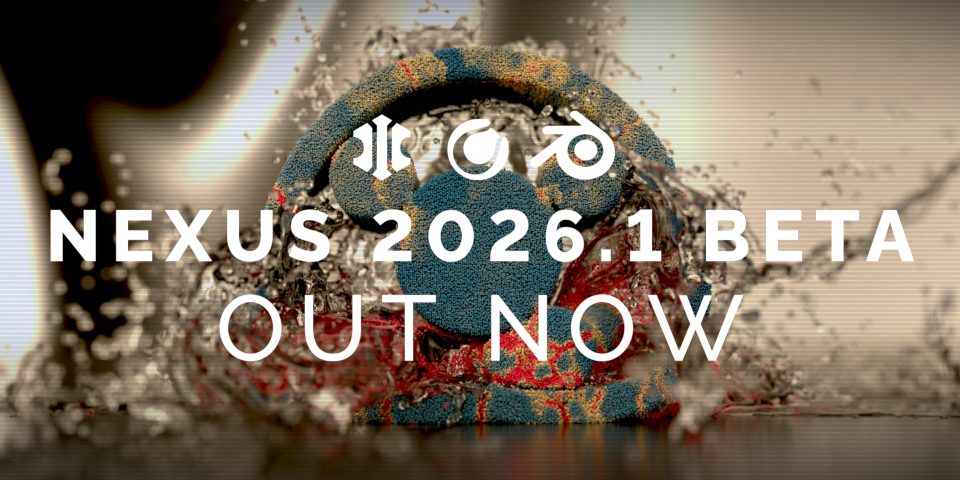
Insydium has released NeXus 2026.1, the latest version of its GPU-accelerated particle-based simulation add-on for Blender and Cimema 4D, in beta.
It’s a major update, unifying the Blender and Cinema 4D editions, adding a new multi-material solver, a new viewport renderer, and a range of new options for manipulating simulations.
The beta is free to anyone with a license of any of Insydium’s products.
A popular particle and multiphysics simulation add-on for Cinema 4D, and now Blender
First released in 2022, NeXus is a GPU-accelerated counterpart to X-Particles, Insydium’s popular CPU-based particle-based multiphysics plugin for Cinema 4D.
As well as particle effects, NeXus includes granular fluid, liquid and gaseous fluid simulation toolsets, and being Vulkan-based, is compatible with AMD, Apple, Intel and NVIDIA GPUs.
The Blender edition of NeXus was released earlier this year after several years in development.
NeXus 2026.1: now unified across Cinema 4D and Blender
One key change in NeXus 2026.1 is that both the Cinema 4D and Blender editions now use the same version of Theron, the underlying, platform-neutral GPU simulation engine.
According to Insydium, that makes NeXus a “unified system across both hosts”.
“A setup behaves the same way in Cinema 4D as it does in Blender” and both host applications “share the same solvers, the same modifiers and the same results”.
New unified multi-material solver lets you blend between material types in one simulation
The update also introduces nxMPM, a new unified multi-material solver, making it possible to mix “liquid, elastic, snow, sand, brittle, metal and foam materials in one simulation”.
It comes with built-in material blending, making it possible to change one type of material into another according to properties like particle age and speed, or material stretching and damage.
To help maintain simulation performance, the solver includes an ‘auto sleep’ system, where particles at rest are no longer computed, until a collider or force ‘wakes’ them again.
Other new tools and solvers
There are also a number of new tools for manipulating simulations, including nxPin, for holding selected particles still to anchor cloth, rope and soft bodies.
nxDeformer causes a mesh to deform to follow the particles of a simulation, preserving its UVs; while nxBind keeps particles in place inside a deforming volume.
The release also introduces nxBioLogic, a cellular growth system with modes mimicking reaction-diffusion effects, differential growth, and the forms of slime moulds and corals.
Updates to existing features
There are also updates to existing features, including particle-meshing system nxMesher, and the nxCollider object, for setting up collisions between particles and scene geometry.
nxMesher gets support for UV advection, so textures move with the liquid surface.
nxCollider gets support for surface adhesion; supports variation for a greater range of properties; and can use a greater range of input types for surface maps, including images and noise.
There are nine new falloff shapes, including Torus, Capsule, Cone and Spline; and 11 new falloff layer types.
The update also introduces a new viewport renderer, again shared by both host applications, which improves voxel drawing for smoke and fire simulations, and FLIP fluid simulations.
Price, system requirements and release date
NeXus 2026.1 is compatible with Blender 4.3+ on Windows, Linux and macOS, and Cinema 4D 19+ on Windows and macOS. It is currently free in beta to anyone with an Insydium license.
New perpetual licenses cost £140 (around $185). NeXus is also available as part of Fused, Insydium’s bundle of Cinema 4D add-ons.
Read a full list of new features in NeXus 2026.1 on Insydium’s website
Have your say on this story by following CG Channel on Facebook, Instagram and X (formerly Twitter). As well as being able to comment on stories, followers of our social media accounts can see videos we don’t post on the site itself, including making-ofs for the latest VFX movies, animations, games cinematics and motion graphics projects.