
Apple unveils new M5 Ultra and M6 processors
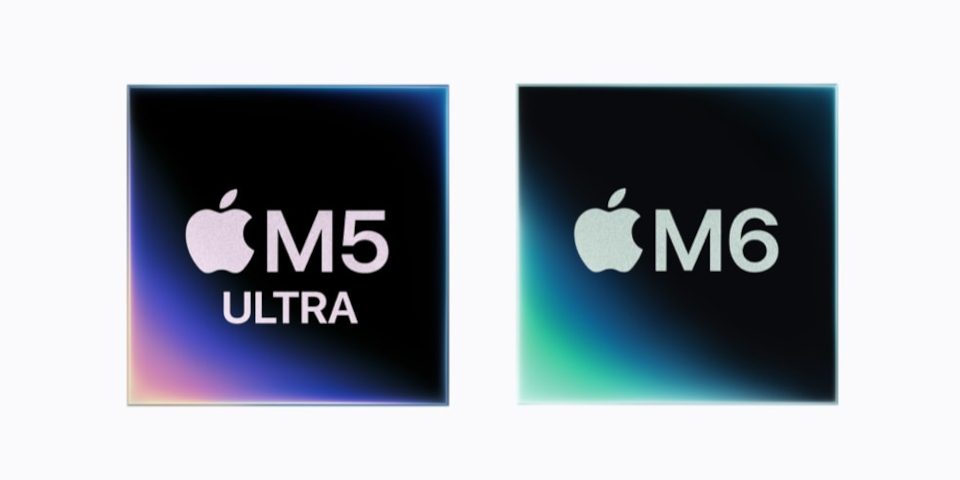
Apple has unveiled the M5 Ultra and M6 processors – the last and most powerful chip in its fifth generation of Apple Silicon processors, and the first and least powerful in the sixth.
Apple describes the M5 Ultra as its “most powerful chip ever”, targeting it at tasks including “3D rendering, visual effects … and running compute-intensive frontier AI models on-device”.
The M5 Ultra is due to ship next month in new Mac Studio models, while the M6 is due in the new Mac mini.
Below, we’ve summarized the new chips’ key specs, and they performs relative to previous-generation processors in CG apps like Nuke and Redshift.
| Apple Silicon processor | |||||
|---|---|---|---|---|---|
| M5 | M5 Pro | M5 Max | M5 Ultra | M6 | |
| Process | 3 nm | 3 nm | 3 nm | 3 nm | 2 nm |
| Unified memory (1) | 32 GB | 64 GB | 128 GB | 512 GB | 32 GB |
| Memory bandwidth | 153 GB/s | 307 GB/s | 614 GB/s | 1200 GB/s | 170 GB/s |
| CPU cores (1) | 10 | 18 | 18 | 36 | 12 |
| GPU cores (1) | 10 | 20 | 40 | 80 | 12 |
| GPU compute (FP32 performance in Teraflops) |
Not published |
Not published |
Not published |
Not published |
Not published |
| Hardware-accelerated ray tracing? | Yes | Yes | Yes | Yes | Yes |
| Neural Engine cores | 16 | 16 | 16 | 32 | 32 (2 x 16) |
| Video decode engines | 1 | 1 | 1 | 2 | TBC |
| Video encode engines | 1 | 1 | 2 | 4 | TBC |
| ProRes encode/decode engines | 1 | 1 | 2 | 4 | TBC |
| AV1 decode | Yes | Yes | Yes | Yes | Yes |
| Launch date | 2025 | 2026 | 2026 | 2026 | 2026 |
(1) Maximum configuration available
Key specifications
The M5 Ultra completes Apple’s M5 processor line-up, begun last year with the M5 chip itself, and rounded out this spring with the M5 Pro and M5 Max processors.
Apple describes the M5 Ultra as its “most powerful chip ever”, aimed at “workloads that demand maximum CPU and GPU performance and unified memory bandwidth”, like rendering and VFX.
As with previous Ultra processors, it’s essentially two existing chips connected together via Apple’s UltraFusion architecture.
In the case of the M5 Ultra, that means connecting two dual-die M5 Max chips to create a quad-die architecture, with an inter-die bandwidth of “over 4.4TB/s”.
As you would expect, that doubles most of the chip’s key specs: the M5 Ultra has twice the CPU cores, GPU cores, Neural Engine cores and video transcoding engines of the M5 Max itself.
According to Apple, that makes it possible to “simultaneously play up to 33 streams of 8K ProRes 422 [footage] at 30 fps” on new Mac Studio models that use the M5 Ultra.
The maximum unified memory – available to both CPU and GPU cores – is actually four times higher than for the M5 Max, and memory bandwidth is also significantly higher.
In contrast, the M6 is the entry-level chip in Apple’s new family of processors, aimed at “everyday users, students, developers [and] AI hobbyists”.
However, it is the first Apple processor to use a 2nm process, and has higher specs than its current-generation counterpart, with two more CPU cores and GPU cores than the M5.
It also features two 16-core Neural Engine units rather than one – not suprisingly, delivering “up to 2x faster performance” for AI processing tasks.
Apple’s launch material doesn’t mention the M6 chip’s video encoding and decoding engines, so we assume that there are no major differences to the M5.
Benchmark comparisons for CG software
So how do those specifications translate into real-world performance in CG software?
Although Apple’s announcement for the M5 Ultra itself doesn’t include any application-specific figures, there are a few on the product webpage for the new Mac Studio.
They’re mainly for AI tasks – even the figures for Nuke are for CopyCat, the software’s machine learning toolset – although there is one benchmark for rendering, in Redshift.
While the webpage also namechecks DaVinci Resolve, Houdini and Photoshop, Apple doesn’t provide any M5 Ultra performance figures for those apps.
It’s also worth noting that, since Apple never actually released an M4 Ultra processor, the comparisons that do exist are to the two-generations-old M3 Ultra.
Comparing the nearest equivalent Mac Studio configurations, the M5 Ultra processor is:
Up to 3.3x faster than the M3 Ultra for CopyCat ML training in Nuke
Up to 1.7x faster than the M3 Ultra for rendering in Redshift
The figures compare systems with an M5 Ultra with 36 CPU cores, 80 GPU cores, and 512 GB of unified memory, and an M3 Ultra with 32 CPU cores, 80 GPU cores, and 512 GB of memory.
Benchmarks for CG software are even scantier when it comes to the M6 processor: although the footnotes on product webpage for the new Mac mini say that Apple has benchmarked it against the older M4 processor in both Affinity and Blender, the webpage doesn’t list the actual figures.
Price and release date
M5 Ultra chips are due to ship in new Mac Studios, and M6 chips in new Mac minis. Both are currently available to pre-order, and due in stores on 22 September 2026.
Pricing for the new Mac Studio starts at $5,499 for a model with a M5 Ultra processor with 30 GPU cores and 64 CPU cores.
Pricing for the new Mac mini starts at $899 for a model with a M6 processor with 12 GPU cores and 12 CPU cores.
Read more about the M5 Ultra and M6 chips on Apple’s website
Have your say on this story by following CG Channel on Facebook, Instagram and X (formerly Twitter). As well as being able to comment on stories, followers of our social media accounts can see videos we don’t post on the site itself, including making-ofs for the latest VFX movies, animations, games cinematics and motion graphics projects.