
3D Gaussian Splats are being added to the glTF standard
Football stadium Empower Field at Mile High visualized in Esri’s ArcGIS Pro using 3D Gaussian Splats. Esri is working with Khronos Group on 3D Gaussian Splat support in the glTF standard.
Posted on 29 August 2025 and updated for the release candidate of the first glTF extension.
Support for 3D Gaussian Splats is being added to the glTF standard for 3D assets.
Standards body Khronos Group is collaborating with the Open Geospatial Consortium and geospatial specialists Niantic Spatial, Cesium and Esri to create a standardized framework for encoding and sharing 3D Gaussian Splats, initially via two experimental new glTF extensions.
An increasingly popular new way to reconstruct and render objects and environments in 3D
3D Gaussian Splatting provides a new way to reconstruct real-world objects from source images or video and render them in 3D.
Like photogrammetry, it begins by generating a point cloud of from a set of source photos, but rather than converting the point cloud to a textured mesh, it converts it to a set of translucent ellipsoids or ‘gaussians’, using machine learning to determine the correct color for each.
The result is a fast-rendering 3D representation of the object or environment being scanned that captures features that are difficult to recreate using traditional photogrammetry workflows, like long thin structures and reflective or semi-transparent materials.
Although it is still a new technology, there are already a range of tools for generating, editing and rendering 3DGS data, and it is now beginning to be supported officially in DCC software, including the V-Ray renderer, and most recently, in Houdini.
A new, more streamlined format in which to transfer 3DGS data between software?
Although 3DGS data is usually transferred between applications in PLY format, support for 3D Gaussian Splatting within glTF files is potentially a more streamlined alternative.
Widely used in web and AR applications, the glTF format is designed to minimize the size of 3D assets and the processing required to unpack them.
At the core of the approach from Khronos Group and its partners is the SPZ format, an open-source file format developed by Niantic Spatial, which compresses 3D Gaussian splats by “up to 90%” while “preserving visual fidelity”.
The Khronos 3D Formats Working Group is now developing two new extensions aimed at standardizing the delivery of Gaussian Splats within glTF assets.
One defines the structure for storing 3D Gaussian splats within glTF, while the other enables storage and streaming using the SPZ format.
These extensions are described “forward-looking” and intended to serve as a “foundational pathway” for long-term support of 3D Gaussian splatting in glTF.
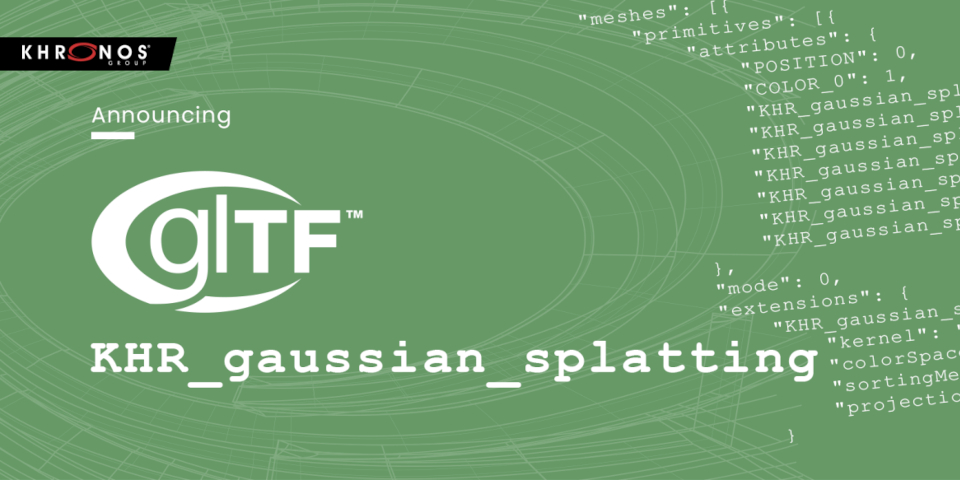
Updated 4 February 2026: Khronos Group has announced the release candidate for the KHR_gaussian_splatting extension.
It’s the first of the two extensions mentioned in the story above, defining the way that 3D Gaussian Splatting data is stored within glTF files.
The extension extends the glTF 2.0 mesh primitive to represent 3DGS attributes, including the position, orientation and scale of each Gaussian, and its color and opacity.
Software that supports glTF 2.0 files will be able to import 3DGS data, preserving cameras and animation, with the data displayed as a point cloud in apps that can’t display splats directly.
Khronos Group’s latest blog post doesn’t directly namecheck the second extension, KHR_gaussian_splatting_compression_spz, for compressing 3DGS data into the SPZ format, but notes that there is also now an alternative using Qualcomm’s L-GSC format.
Read more about the addition of 3DGS to the glTF standard on Khronos Group’s blog
Read more about the release candidate for the KHR_gaussian_splatting extension
Have your say on this story by following CG Channel on Facebook, Instagram and X (formerly Twitter). As well as being able to comment on stories, followers of our social media accounts can see videos we don’t post on the site itself, including making-ofs for the latest VFX movies, animations, games cinematics and motion graphics projects.