
3Dflow releases 3DF Zephyr 9.0 with 3D Gaussian Splatting
3Dflow has released 3DF Zephyr 9.0, the latest version of its photogrammetry software.
The update adds a new 3D Gaussian Splatting toolset, making it possible to generate splats from real-world source images and videos as well as point clouds and textured geometry.
A capable photogrammetry tool for entertainment, architectural and scientific work
First released over a decade ago, 3DF Zephyr is a capable photogrammetry tool, reconstructing detailed 3D models of real-world objects or environments from images or videos.
It uses a multi-phase workflow, with the initial Structure from Motion (SfM) stage establishing the structure of the 3D scene from the source images, generating a sparse point cloud.
A Multi-view Stereo (MvS) stage generates a dense point cloud, from which 3DF Zephyr can extract a textured mesh.
3DF Zephyr is used for both entertainment work like games and VFX, and for architectural and scientific work, with the full edition also including Lidar and aerial surveying tools.
The software is GPU-accelerated: initially only on NVIDIA hardware via CUDA, but with 3DF Zephyr 8.0 having introduced OpenCL support, now also on AMD and Intel GPUs.
New Gaussian Splatting toolset generates splats from the existing point clouds
The main new feature in 3DF Zephyr 9.0 is the Gaussian Splatting toolset, providing an alternative to specialist tools like Postshot or Nerfstudio for generating 3D Gaussian Splats.
Splats can be generated from the SfM spare point cloud or the MvS dense point cloud – which, for maximum quality, can be optimized with 3DF Zephyr’s photoconsistency algorithm first.
The three workflows make it possible to trade speed of calculation against the quality of the splats generated.
Splat generation is currently only supported on a single GPU, and according to the online documentation, CUDA GPUs give better performance than OpenCL GPUs.
Other new features and workflow improvements
Other changes include support for displaying satellite and hybrid map tiles inside the viewport, making it possible to visualize scanned 3D environments in their geographical context.
A new camera controller provides a tripod-style mode for navigating 3D scenes, similar to the one in 3DF Scarlet, 3Dflow’s laser scan management software.
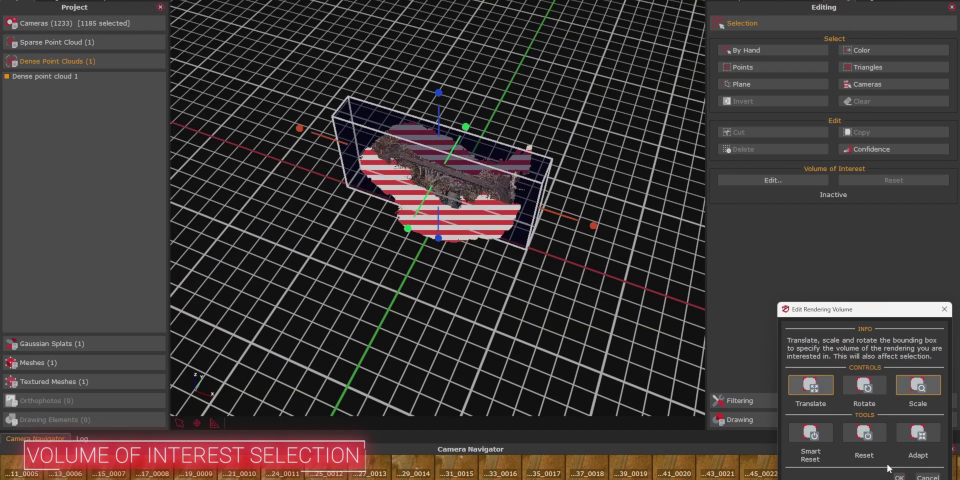
Workflow improvements include a consistent target selector and support for volume of interest selection across all of 3DF Zephyr’s selection subtools, as shown in the image above.
It is also now possible to export tiled meshes in Esri’s i3s format, and video in HEIF format.
Price and system requirements
3DF Zephyr 9.0 is compatible with 64-bit Windows 10+.
The free version works with up to 50 source images or video frames, and runs on a single GPU.
The Lite edition supports unlimited source images and two GPUs, and costs $209.
The full edition supports unlimited source images and multiple GPUs, and adds a range of advanced features. A perpetual licence costs $4,600; subscriptions cost $290/month.
Read a full list of new features in 3DF Zephyr 9.0 on 3Dflow’s blog
Read more about the new features in 3DF Zephyr in the online documentation
Have your say on this story by following CG Channel on Facebook, Instagram and X (formerly Twitter). As well as being able to comment on stories, followers of our social media accounts can see videos we don’t post on the site itself, including making-ofs for the latest VFX movies, animations, games cinematics and motion graphics projects.