
Maxon releases Redshift 2026.2
🚨 #Maxon #Redshift 2026.2 is here!
⚡️ Tessellation-free displacement delivers ultra-detailed surfaces—no tessellation overhead, just speed.
🎯 UV Context Projection node lets you control texture placement with multiple transforms & projection types, including triplanar pic.twitter.com/A39aOEQS9N— Maxon Redshift (@maxonredshift) December 3, 2025
Maxon has released Redshift 2026.2, the latest version of the GPU renderer for VFX, motion graphics and visualization work.
The update adds a Texture Displacement method, making it possible to work with displacement more interactively, and a new UV Context Projection node to streamline texture adjustment.
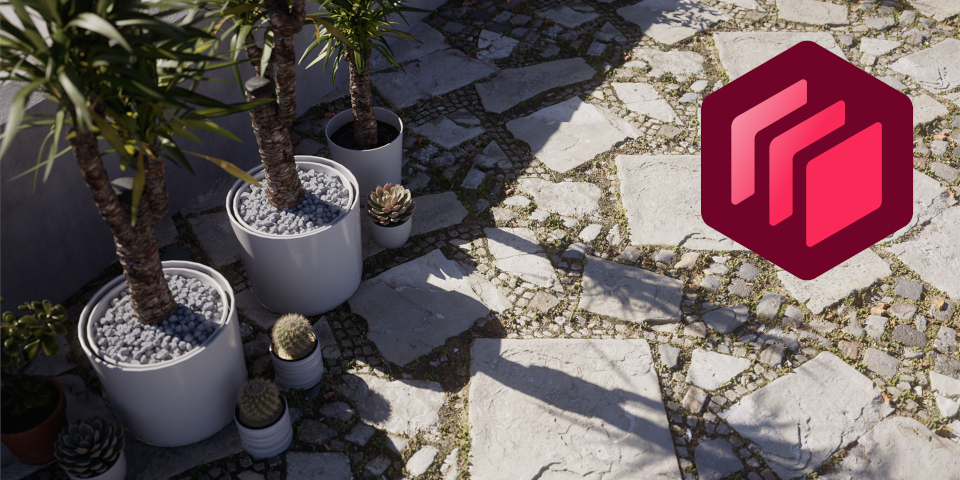
New Texture Displacement method makes it possible to work interactively
Redshift 2026.2 overhauls the way the software handles displacement, adding a new Texture Displacement method, in addition to Vertex Displacement.
Texture Displacement is less versatile than Vertex Displacement, but doesn’t require the base mesh to be tessellated first, making it possible to work more interactively.
Maxon describes it as suited to adding detail to large, low-poly surfaces like walls or ground planes, like those shown in the render at the top of the story.
You can find more information on how the two methods work, and their relative strengths and weaknesses, in the online documentation.
Vertex Displacement is actually now enabled by default across the entire scene, although it is possible to set the displacement method used for scene objects on a per-object basis.
New UV Context Projection node streamlines texture adjustment
The other major new feature in Redshift 2026.2 is UV Context Projection, a new utility node that applies the same texture mapping across all of the textures connected to a material.
It makes it possible to adjust all of the textures simultaneously, as shown in the video above, rather than having to reposition, scale or rotate each one individually.
UV Context Projection lacks some of the options available when managing textures through the Texture Sampler, but Maxon now recommends using it wherever possible.
You can read more about how it works in the online documentation, and see suggested use cases in this forum thread.
Now supports AMD RDNA 4 GPUs from the Radeon RX 9000 Series
In addition, Redshift now supports the Radeon RX 9000 Series, AMD’s new RDNA 4 GPUs.
The software has officially supported rendering on AMD as well as NVIDIA and Apple Silicon GPUs since Redshift 3.6, released last year.
Price and system requirements
Redshift 2026.2 is compatible with Windows 10+, glibc 2.28+ Linux and macOS 14.0+. In the release notes, the update is also referred to as ‘Redshift 2025.12’.
The integration plugins are compatible with 3ds Max 2018+, Cinema 4D 2023+, Houdini 19.0+, Katana 5.0+ and Maya 2018+ (Maya 2022+ on Linux). The Blender plugin is no longer updated.
The software is rental-only. Subscriptions cost $49/month or $289/year.
Read a full list of changes in Redshift 2026.2 on the Redshift forum
(Login required)
Have your say on this story by following CG Channel on Facebook, Instagram and X (formerly Twitter). As well as being able to comment on stories, followers of our social media accounts can see videos we don’t post on the site itself, including making-ofs for the latest VFX movies, animations, games cinematics and motion graphics projects.