
QuadSpinner releases Gaea 2.0
Posted on 6 October 2023, and updated for the final release.
QuadSpinner has released Gaea 2.0, a major update to its next-gen terrain design tool.
The release rewrites the software core to improve performance by “several magnitudes”, and reworks the procedural erosion system.
Powerful procedural terrain generation plus artist-friendly direct sculpting
First released in 2019, Gaea provides an artist-centric approach to terrain generation for games, combining powerful procedural controls with a range of direct input methods.
As well as by creating and editing a conventional scene graph, users can control terrain forms through a Photoshop-style layer system or by direct sculpting.
The software includes a procedural erosion system capable of mimicking snow, scree and sediment deposition, which can even be used to ‘sculpt’ fine details into a terrain.
Once generated, terrains can be exported as meshes, point clouds or height maps, with the option to generate LODs or variants via a built-in terrain mutation system.
The software is used for both game development and visual effects work, with testimonials on QuadSpinner’s website ranging from MattePaint.com to Respawn Entertainment.
Rewritten core improves performance by orders of magnitude
According to QuadSpinner, Gaea 2 represents a major rewrite of the software’s core that improves overall performance by “several magnitudes”.
As well as optimising the code, some processes have been GPU-enabled, with CPU fallbacks.
The node graph has been redesigned to reduce the the learning curve for new users, with new node modifiers to make it possible to generate terrain with lighter graphs.
New ‘primitives + landscapes + surfaces’ workflow for multi-scale design of terrain
The release also rethinks terrain design workflow to “address the biggest problems artists face in achieving control over procedural shapes”.
The ‘primitive + lookdev’ workflow from Gaea 1 has been superseded with what QuadSpinner describes as ‘primitive + landscapes + surfaces’.
Gaea 2.0’s new Surface nodes apply smaller-scale erosion effects to parts of a terrain after it has been generated, making terrain design a multi-stage, multi-scale process.
New Erosion 2 algorithm makes erosion effects ‘up to 10x’ faster
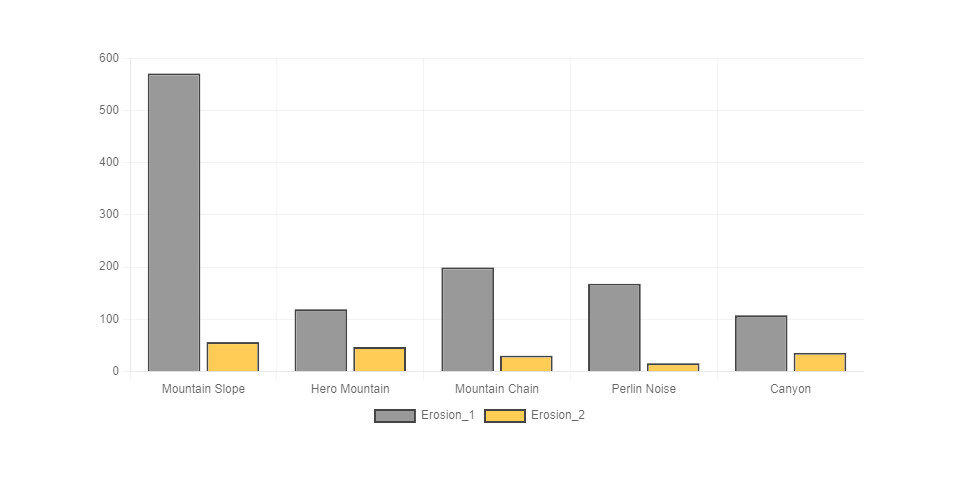
Other new features include the Erosion 2 algorithm, described as being capable of “shapes previously unavailable” in Gaea, and as preserving the original character of the terrain better.
It is provided in parallel to the existing Erosion 1 algorithm, although it’s much faster, with speed boosts of “up to 10x”.
You can see QuadSpinner’s performance comparisions for different types of terrain above.
New bridge plugins for Houdini and Unreal Engine 5
In addition, Gaea 2.0 comes with Gaea2Unreal, a bridge plugin for Unreal Engine 5, to streamline the process of exporting terrain to the game engine.
A similar plugin for Houdini, Gaea2Houdini, is available directly from the Houdini Launcher as part of the optional SideFX Labs tools.
Macros and God Mode due in future Gaea 2.x releases
Correction: This story originally incorrectly stated that Gaea 2.0 included support for macros and the new ‘God mode’ for developing very large worlds.
Both were included in the original Gaea 2 preview, but macros are now scheduled for Gaea 2.3, and God mode for Gaea 2.4. You can see the current product roadmap here.
Price, system requirements and release date
Gaea 2.0 is compatible with Windows 10+.
The Indie edition, which caps resolution at 8K, costs $99; the Professional and Enterprise editions, which provide 256K resolution plus a range of advanced features, cost $199 and $299.
There is also a free Community Edition for non-commercial use, which provides access to most of the key tools, but which caps export resolution at 1K.
Read more about the new features in Gaea 2.0 in the online documentation
Have your say on this story by following CG Channel on Facebook, Instagram and X (formerly Twitter). As well as being able to comment on stories, followers of our social media accounts can see videos we don’t post on the site itself, including making-ofs for the latest VFX movies, animations, games cinematics and motion graphics projects.