
Adobe releases Substance 3D Painter 12.1
Adobe has released Substance 3D Painter 12.1, the latest version of the 3D texture painting software for games, animation, motion graphics and VFX.
The update reworks texture baking, adding support for continuous rebaking and skew correction painting, and adds a new automatic UV unwrapping mode for hard surface models.
Continuous rebaking removes the need to trigger mesh bakes manually
Substance 3D Painter 12.1 reworks the software’s baking toolset, used to bake geometry information from the model being textured into 2D textures like normal and curvature maps.
The maps are then used by other features in the software, like Smart Maps and Smart Materials.
The update introduces support for continuous rebaking, meaning that maps update each time a user updates their baking parameters, rather than having to trigger the bake manually.
Paint skew corrections directly onto a 3D model to fix normal map errors
The other major change is the option to paint skew corrections.
The workflow makes it possible to fix artefacts in baked maps by painting onto the low-poly mesh to control the normal direction used in baking.
Painted areas use normals from the underlying geometry, while unpainted areas continue to use the – sometimes inaccurate – default baking cage that Substance 3D Painter generates.
Corrective fills can be created using a combination of the brush, eraser and polygon fill tools, with the usual control options like flow and opacity available when using the brush.
In addition, edge protection settings automatically ignore the painted correction near edges on the geometry, to preserve a smooth flow of normals.
New hard surface mode for automatic UV unwrapping
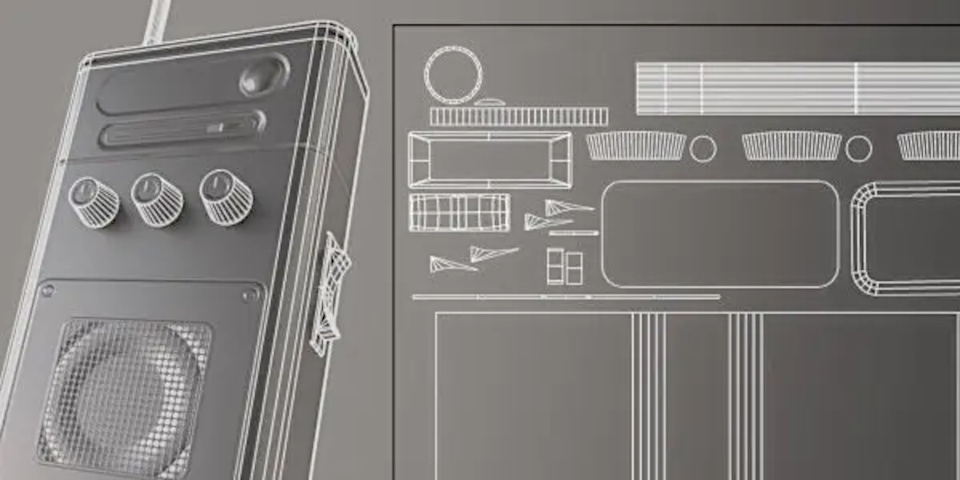
Substance 3D Painter’s automatic UV unwrapping system, which makes it possible to paint on 3D models that don’t have existing UVs, has also been updated.
While the toolset was previously geared towards organic models like characters, Substance 3D Painter 12.1 introduces a new hard surface mode for mechanical models.
It minimizes UV distortion on such models, and produces UV layouts aligned orthographically.
The workflow could be used on assets for game development or animation work, like machinery or vehicles, or on 3D models for product visualization.
OpenPBR shading now used by default
In addition, Substance 3D Painter 12.1 now uses OpenPBR shading by default.
The new open material standard supersedes both the old Adobe Standard Material and Autodesk Standard Surface, and is increasingly being adopted in other DCC applications.
When creating a new project without a template, Substance 3D Painter now assigns an OpenPBR shader to imported geometry, and uses OpenPBR naming conventions when exporting textures.
It is also possible to render OpenPBR materials in the integrated Iray renderer.
Adobe previously made OpenPBR shading the default in Substance 3D Designer 16.0, the latest version of its material authoring software.
Other workflow improvements
Workflow improvements include a unified undo history: with the introduction of corrective skew painting, baking and painting modes now share a common history stack.
It is also now possible to add or remove multiple material channels at once via the Texture Set settings; and to flatten instanced layers or groups across every Texture Set where they appear.
Price and system requirements
Substance 3D Painter 12.1 is available for Windows 11, RHEL 8.6/9.2+ and Ubuntu 22.04+ Linux and macOS 12.0+.
Perpetual licences are available via Steam and cost $199.99.
The software is also available via Adobe’s Creative Cloud-based 3D and AR subscriptions.
Substance 3D Texturing subscriptions cost $24.99/month or $249.99/year; Substance 3D Collection subscriptions cost $59.99/month or $599.99/year.
Read a list of new features in Substance 3D Painter 12.1 in the online release notes
Have your say on this story by following CG Channel on Facebook, Instagram and X (formerly Twitter). As well as being able to comment on stories, followers of our social media accounts can see videos we don’t post on the site itself, including making-ofs for the latest VFX movies, animations, games cinematics and motion graphics projects.