
NVIDIA launches DLSS 4.5
NVIDIA has launched DLSS 4.5, the latest version of its suite of ‘neural rendering’ technologies designed to boost viewport frame rates in games and CG software.
It’s a sizeable update, introducing a second-generation transformer architecture for Super Resolution render upscaling, plus support for 6X Dynamic Multi Frame Generation.
Below, we’ve summarized what the changes mean, when they will become publicly available – and which NVIDIA GPUs you need to take advantage of them.
DLSS: AI tech to improve viewport frame rates in games and CG software
First introduced in 2019, DLSS (Deep Learning Super Sampling) is a set of ‘neural rendering’ technologies that use AI to improve frame rates and image quality in real-time applications.
The initial version was primarily an image-upscaling system, enabling software to render the screen at lower resolution, then upscale the result to the actual resolution of the user’s monitor.
Later releases introduced frame-generation algorithms, generating additional frames in between conventionally rendered frames, further increasing viewport frame rates.
Although primarily targeted at games, and game engines like Unity and Unreal Engine, DLSS is also supported in a range of CG software, including Chaos Vantage, D5 Render and Twinmotion.
Unlike the AMD equivalent, FSR (FidelityFX Super Resolution), or Intel’s XeSS (Xe Super Sampling), DLSS doesn’t support other manufacturer’s hardware, and requires a NVIDIA GPU.
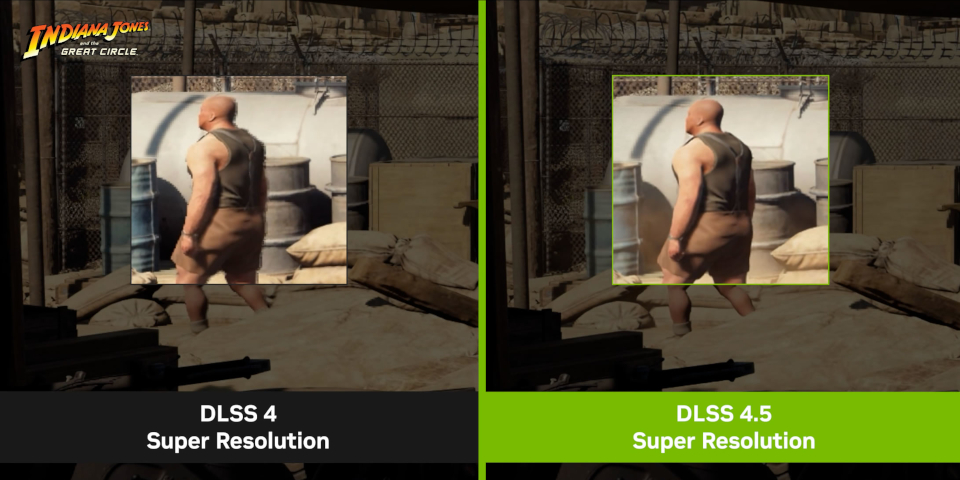
DLSS 4.5: second-gen Super Resolution for higher-quality image upscaling
DLSS 4.5 features a number of improvements, some available now, some later this year.
Render upscaling gets its first major upgrade since the original release, in the shape of the second-generation transformer architecture for Super Resolution.
Whereas the original operated in logarithmic space to reduce flickering, resulting in muted lighting, the new model operates in linear space, preserving tonal contrast in upscaled images.
The update also reduces temporal artifacts like ghosting, and improves antialiasing.
You can gauge how much of a difference the changes make to the look of current games in the before-and-after comparisons in NVIDIA’s blog post announcing DLSS 4.5.
‘Minor’ effect on rendering performance, at least on newer NVIDIA GPUs
The new model is more computationally expensive, but can take advantage of support for FP8 precision in the Tensor AI cores in newer NVIDIA GPUs, for a “minor performance tradeoff”.
FP8 processing is available in Ada Lovelace and Blackwell GPUs: the GeForce RTX 40 Series and 50 Series consumer cards and their workstation counterparts from the RTX PRO series.
Tom’s Hardware reports that the new model will also run on older Turing and Ampere GPUs, like the GeForce RTX 20 and 30 Series, but that the effect on performance isn’t guaranteed.
If you own an older card, you can experiment for yourself: second-generation Super Resolution is available now in beta versions of the NVIDIA App, ahead of an official launch next week.
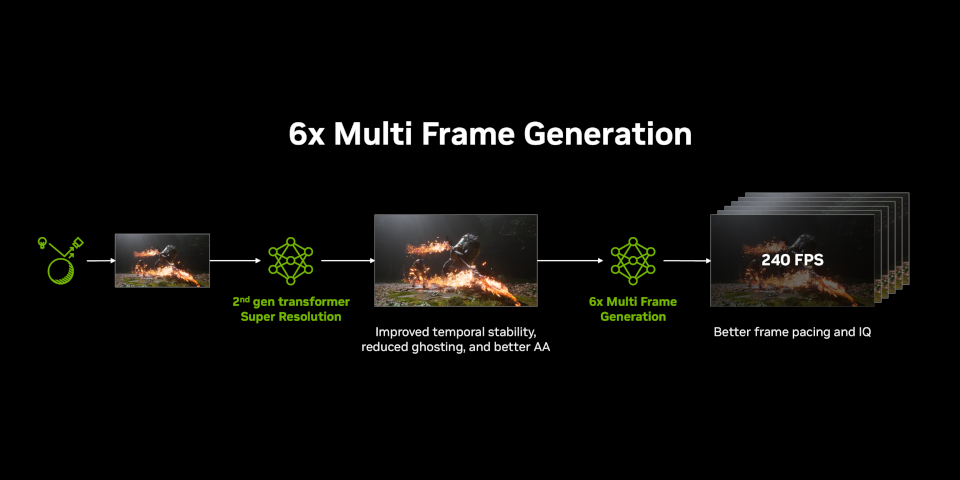
Multi Frame Generation: now generates even more frames, and adjusts dynamically
DLSS 4.5 will also makes some pretty significant improvements to frame generation.
Multi Frame Generation gets a new 6X mode, making it possible to generate up to five additional frames for each natively rendered one, up from three in the original version in DLSS 4.
The update also makes Multi Frame Generation dynamic.
Rather than sticking to a fixed multiplier, software that supports DLSS will be able to shift between different multipliers to balance frame rate against visual quality.
6X Mode and Dynamic Multi Frame Generation will be available via the NVIDIA App “this spring”. Multi Frame Generation requires a Blackwell GPU: the GeForce RTX 50 Series or equivalent.
Release dates
DLSS 4.5 Super Resolution is available as a beta feature in the NVIDIA App, and will be launched officially on 13 January. Dynamic Multi Frame Generation is available in spring 2026.
Read more about DLSS 4.5 on NVIDIA’s blog
Have your say on this story by following CG Channel on Facebook, Instagram and X (formerly Twitter). As well as being able to comment on stories, followers of our social media accounts can see videos we don’t post on the site itself, including making-ofs for the latest VFX movies, animations, games cinematics and motion graphics projects.