
How Dupp Film created a hybrid CG mermaid for Summer of 1985
VFX Supervisor Anders Nyman reveals how a combination of practical effects and Dupp Film’s CG work created the unsettling realistic mermaid for Swedish series Svärtan (Summer of 1985).
When director Björn Stein set out to bring the supernatural creature in Svärtan (Summer of 1985) to life, the goal was never to create a traditional fantasy mermaid.
Instead, the team wanted something that felt like it truly belonged in the cold waters of the Baltic Sea: a creature that was unsettling, expressive and believable.
The solution was a seamless collaboration between practical and digital effects, with the finished character relying on VFX in every shot in which she appears. Rather than replacing the practical work, VFX became an extension of it.
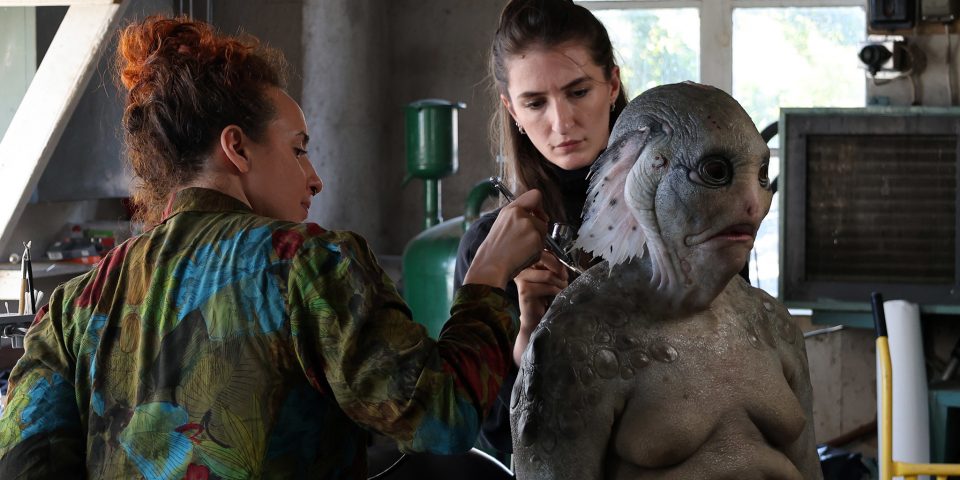
Special Makeup Effects artists Anna Kießer and Viktoria Stieber apply the practical mermaid costume to actor Rebecka Labbé: a four-hour process. Photo: Göran Lundström.
Designing a Baltic Sea mermaid
Two-time Academy Award nominee Göran Lundström led the creature design for Summer of 1985, creating a full upper-body silicone suit for actor Rebecka Labbé.
“Like in many productions, it was decided from the start that certain parts of the mermaid would be created with VFX,” says Lundström. “But I don’t think it influenced our design decisions very much. I always try to design things as practically solvable solutions.”
For the look of the creature, director Björn Stein wanted something closer to a fish than the elegant fantasy mermaids often seen on screen.
“He leaned more towards a fish-inspired creature than a beautiful mermaid,” says Lundström. “Creature from the Black Lagoon, The Shape of Water, and Abe Sapien from Hellboy had already explored similar territory. My challenge was differentiating our creature from those [designs] while making her feel female at first glance.”
The Baltic Sea itself became an important source of inspiration. Lundström studied local fish species, particularly their muted green colour palettes and natural patterning, coming up with a paint treatment for the costume inspired by their color combinations.
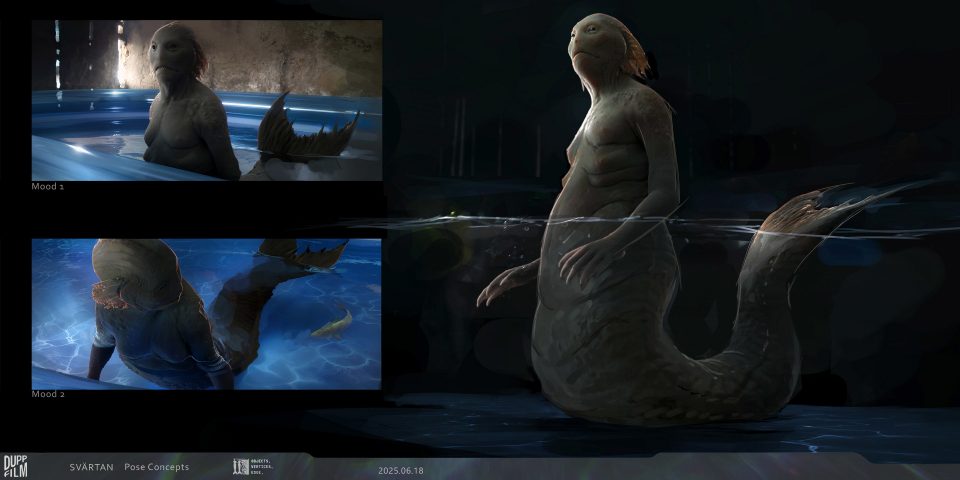
Concept art for the mermaid, created by Isidor Swande.
Every shot was a hybrid
The practical costume performed remarkably well throughout production. Labbé was able to swim, dive from boats and perform physically demanding scenes while wearing the suit.
But while the costume provided their foundation, every mermaid shot was digitally enhanced.
Initially, the production intended to use contact lenses to create the creature’s eyes. But during filming, it quickly became clear that the lenses severely limited Labbé’s performance.
Instead, the VFX team, led by VFX Supervisor Anders Nyman, replaced the mermaid’s eyes digitally in every single shot.
What began as a practical necessity became one of the creature’s defining characteristics. The VFX artists added tiny focus shifts, subtle pupil dilation and almost imperceptible movements that gave the mermaid an inner life.
Even blinking became a surprisingly complex design decision.
“The original concept was that she should behave more like a fish than a human. Fish don’t blink because they’re underwater. But we still needed a way for her to express emotion,” says Nyman.
Rather than using a human blink, the team settled on a subtle lower-lid blink that felt slightly unnatural without becoming distracting. During moments when the creature enters a more predatory state, her pupils transform into elongated oval shapes.
The VFX team also added animated gills to the mermaid, and digital mouth replacements were used in several shots. The mermaid’s tail is always CG whenever it appears on screen.
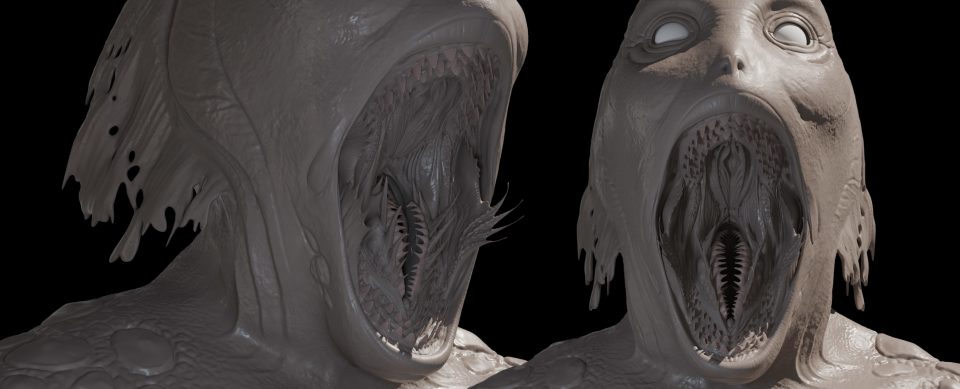
Early test renders of the inside of the mouth of the 3D mermaid model.
Building the digital mermaid
The digital asset itself was created in Blender and Maya, and textured in Substance 3D Painter, with the artists working from hundreds of detailed reference photos of the practical suit.
Rigging and animation were completed in Maya, simulations in Houdini, and final rendering was done with V-Ray. The shots were composited in Nuke.
Around 80 shots combine the practical performance with digital enhancements, while approximately 20 shots feature a fully digital mermaid. These include underwater sequences, swimming shots, attacks, and several scenes where the creature crawls across land.
Finding the same character in each shot
One of the greatest artistic challenges in Summer of 1985 wasn’t making the mermaid look realistic: it was making her feel like the same individual in every shot.
The most difficult sequence involved a close-up where the mermaid screams at the camera.
During one review, director Björn Stein summed up the problem with a single sentence: “It looks like another cartoonist has drawn my favourite cartoon.”
Although the digital model was built directly from the practical costume, the character’s identity had somehow drifted.
“We had to go back and analyze why she no longer felt like the same character,” says Nyman. “Ironically, the answer was usually to animate less. The more restrained we were, the more believable she felt.”
One creature, two technologies
Neither the practical costume nor the digital creature alone defines the mermaid in Summer of 1985. Instead, the character exists somewhere between the two.
The practical suit established the physical presence. The VFX extended that presence into places where the costume simply couldn’t go, and created subtle facial performances that would have been impossible to capture on set.
“I hope nobody watches the series wondering whether she’s practical or CGI,” says Nyman. “Hopefully she just feels like an ordinary Baltic Sea mermaid.”
Summer of 1985 screened in Sweden earlier this year. International releases are now planned.
Find full artist credits for Svärtan (Summer of 1985) on IMDb
Have your say on this story by following CG Channel on Facebook, Instagram and X (formerly Twitter). As well as being able to comment on stories, followers of our social media accounts can see videos we don’t post on the site itself, including making-ofs for the latest VFX movies, animations, games cinematics and motion graphics projects.