Faceform releases Wrap 2025.11 and Wrap4D 2025.11
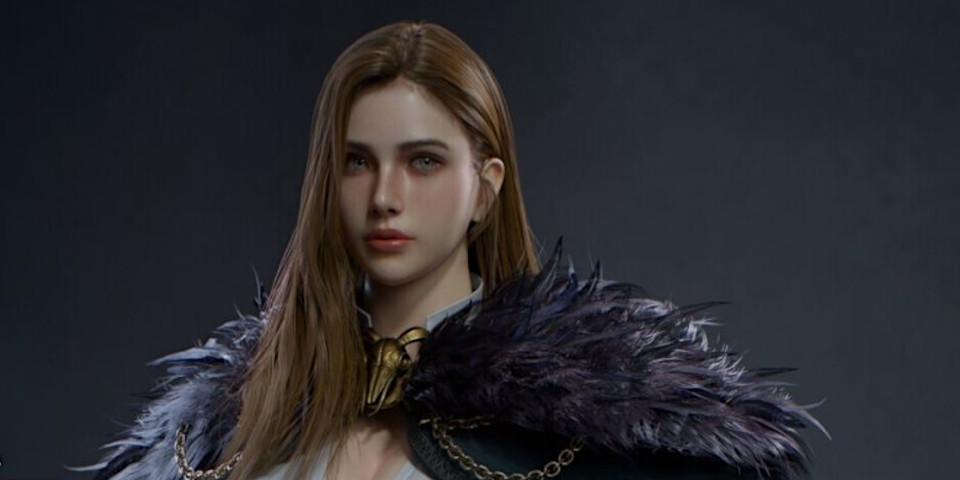
A character created by 3D artist Jo Jehyun, used as a promotional image for Wrap 2025.11.
Faceform has released Wrap 2025.11 and Wrap4D 2025.11, the latest versions of its topology transfer software for creating CG characters from 3D scan data.
Wrap 2025.11 gets new nodes for retargeting blendshapes and facial animations between characters, and for generating stretch-compression masks.
Wrap4D 2025.11 has the same new features as Wrap, plus new Project and Script nodes to help set up more complex production workflows, and a new set of audio nodes.
(Full disclosure: both updates were released late last month, but we didn’t manage to write about them at the time.)
Powerful standalone tools for processing 3D scans of actors for games and VFX work
First released in 2014, Wrap is a topology transfer tool for 3D scan data.
It transfers clean topology from a reference mesh to a raw 3D scan, speeding up the process of creating animation-ready digital doubles of actors.
The process is semi-automatic, and due to Wrap’s node graph-based architecture, adjustments made for one scan can then be rolled out to others.
The extended edition, Wrap4D, is part of a set of tools for creating time sequences of scans from head-mounted camera rigs, for capturing an actor’s facial expressions in 3D.
The software is used by game developers and visual effects studios including EA Vancouver, Rocksteady Studios, Framestore and The Mill.
Wrap 2025.11 and Wrap 4D 2025.11: retarget blendshapes and animation more easily
Both editions of the software get a new DeltaTransfer node for retargeting facial animation.
It makes it possible to retarget vertex expressions or series of blendshapes between characters by transferring deformation deltas from one neutral mesh to another.
Another new node, StretchVertexMask, computes stretch-compression masks for blendshapes or animations, either for further processing or for use in applying effects.
Workflow improvements include the ability to open project files by dragging them into the Wrap window.
Wrap4D 2025.11 only: new Project and Script nodes help set up complex pipelines
Wrap4D users also get a new Project node, which computes an entire Wrap4D project inside one node.
With it, users can set up complex workflows much more easily, by chaining together multiple sub-projects inside a single project.
In addition, the new Script node runs external Python scripts as part of the node graph, again making it possible to set up more complex pipelines.
Wrap4D 2025.11 only: new nodes for working with audio
There are also a new set of nodes for working with audio inside Wrap4D, making it possible to play back animations with synchronized audio.
LoadAudio loads a WAV file, or extracts audio from a video file; MergeAudio concatenates or overlaps two audio sources; and ModifyAudio adjusts the gain level.
Another new node, ModifyBlendRigControls, makes it possible to edit blendshape rig controls procedurally, multiplying, offsetting, clamping or symmetrizing controls across a given frame range.
Suggested uses include making quick final tweaks or batch adjustments to animations.
Price and system requirements
Wrap 2025.11 and Wrap4D 2025.11 are compatible with Windows and Linux.
For users with revenue under $100,000/year, perpetual node-locked Indie licenses of Wrap cost $570.
Full Professional licenses of Wrap cost $1,070 for node-locked licenses; $1,470 for floating licenses. The software is free to students and educational institutions.
Wrap4D is priced on enquiry.
Read a full list of new features in Wrap 2025.11 and Wrap4D 2025.11
Have your say on this story by following CG Channel on Facebook, Instagram and X (formerly Twitter). As well as being able to comment on stories, followers of our social media accounts can see videos we don’t post on the site itself, including making-ofs for the latest VFX movies, animations, games cinematics and motion graphics projects.