
Maxon announces more details of Digital Twin
Maxon has posted more details of Digital Twin, its new product visualization and marketing software, following the negative feedback its original announcement attracted on social media.
The upcoming standalone application turns a CAD file or 3D model of a real-world product into a ‘digital prototype’ that can be reused across graphics for packaging, print ads and videos.
It will integrate with a range of design tools, including “AI-enabled … applications and third-party AI tools”: something that has proven unpopular with Maxon’s social media followers.
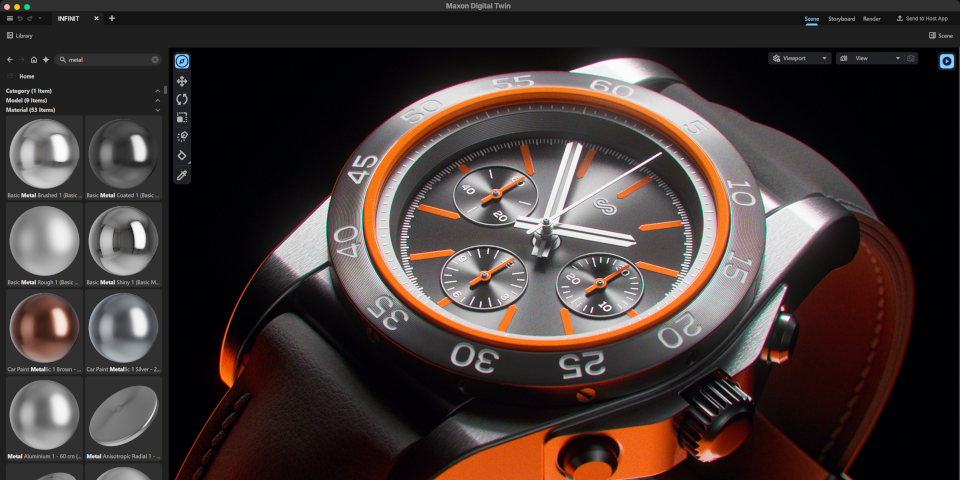
A new tool for creating product marketing visuals
Digital Twin is a move outside Maxon’s traditional user base of entertainment artists, being aimed at “marketing communicators”, particularly for consumer goods.
The software converts a CAD or 3D product model into a “photorealistic digital prototype”, with users able to set up materials, textures and lighting, and generate photorealistic renders.
The rendered model can then be integrated into a background image: either one created conventionally, or using generative AI tools in third-party applications.
Maxon’s blog post doesn’t say exactly which tools Digital Twin will integrate with, but Forbes reports that it the list includes Affinity, Figma, Photoshop and Adobe Express.
Digital Twin can then automatically match the lighting and perspective of the product model to the background, ensuring that the two mesh visually.

Digital Twin is intended to enable marketers to create consistent promotional visuals of real-world products across many different formats, including ads, social media and packaging.
New blog post provides some clarity on what Digital Twin does and does not do…
Maxon’s blog post seems to be, at least in part, an attempt to combat the negative feedback that Digital Twin attracted when it was announced on its social media channels last week.
Many users concluded that the announcement of a tool to create a “marketing-ready asset with AI-generated backgrounds” referred to an upcoming feature in an existing Maxon application, like Cinema 4D or ZBrush, and that the company was developing its own AI models.
According to the FAQs in the blog post, neither is the case.
…but is still attracting criticism on social media
But while the blog post brings clarity about what Digital Twin does, it hasn’t ended the negative feedback.
Although the comments on Maxon’s latest social media posts are more mixed, they’re still mainly critical, with some seeing Digital Twin as a way for marketers to dispense with 3D artists.
On Instagram, one founder of a brand graphics and visualization firm comments that Maxon is “about to make all their users obsolete in the name of making easy visuals”.
Maxon isn’t alone in creating software for this market sector: both Adobe’s Substance 3D Stager and KeyShot’s KeyShot Studio follow similar workflows, and both have generative AI capabilities.
However, it is a new departure for the company – and, it seems, for some of its users, an unwelcome one.
Price, release date and system requirements
Digital Twin is still in development. Maxon hasn’t announced a release date or pricing, or officially confirmed which other applications it will integrate with.
Read Maxon’s blog post announcing Digital Twin
Have your say on this story by following CG Channel on Facebook, Instagram and X (formerly Twitter). As well as being able to comment on stories, followers of our social media accounts can see videos we don’t post on the site itself, including making-ofs for the latest VFX movies, animations, games cinematics and motion graphics projects.